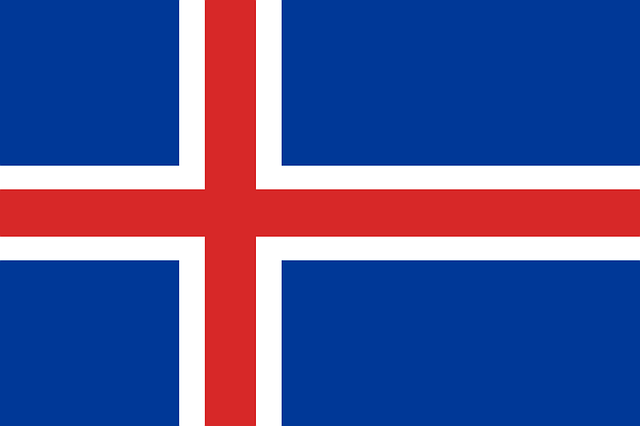

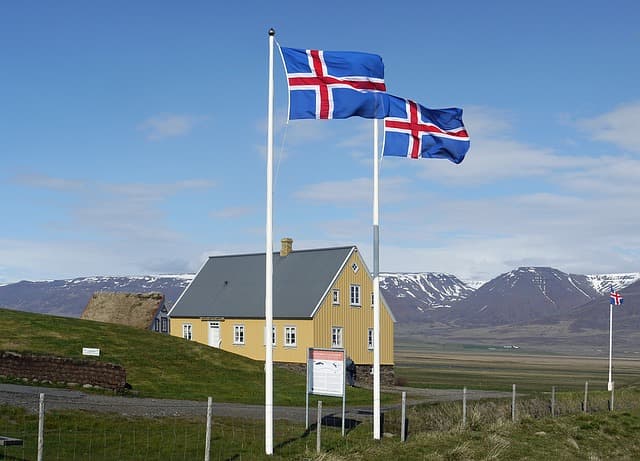
The Icelandic flag is the blue, white and red cross you'll see flying outside farmhouses, on fishing boats in small harbours, and above government buildings in Reykjavik. If you're planning a self-drive trip around the island, it's a small piece of Icelandic culture worth understanding before you go, it turns up more often than you'd expect, from Keflavik Airport to remote guesthouses along the Ring Road.
Short answer: The Icelandic flag is a red Nordic cross outlined in white, set on a blue background. Blue represents Iceland's mountains and the sea surrounding it, white represents snow and ice, and red represents the fire of its volcanoes. The current design was created by Matthías Þórðarson and became Iceland's official flag in 1915, after an earlier blue-and-white version was rejected.
Iceland flag colors and what they represent
Each of the three colors on the Icelandic flag stands for a natural feature of the country itself, rather than a political or religious symbol. That's part of why the explanation is short, Icelanders describe it in a single sentence, and the flag has stayed unchanged since it was adopted.
| Color | What it represents | Where you'll notice it in Iceland |
|---|---|---|
| Blue | Iceland's mountains and the surrounding North Atlantic Ocean | Sea views along the Ring Road, mountain ranges, the Icelandic Coast Guard |
| White | Ice and snow | Glaciers, snowfields, winter landscapes |
| Red | The fire of Iceland's volcanoes | Lava fields, volcanic craters, geothermal areas |
If you're driving through the Highlands or past a glacier tongue like Sólheimajökull, it's easy to see why these three colors were chosen, blue, white and red aren't abstract here, they're the landscape.
The history of the Icelandic flag's design
The flag Icelanders fly today wasn't the first one proposed, and it took nine years to become law. In 1906, a committee was formed because Icelanders wanted a flag of their own, distinct from Denmark's, which still ruled Iceland at the time.
According to standard historical accounts, Matthías Þórðarson first presented the blue, white and red design we know today, but the committee rejected it. Instead, they voted for a simpler design nicknamed "the White Blue", a blue flag with a white cross and no red, which Icelanders came to like a great deal. The problem was that it looked very similar to the flag of Greece.
Kristján X, the King of Denmark and therefore of Iceland at the time, objected to "the White Blue" for exactly that reason and asked for a new design. Matthías Þórðarson's original blue-white-red version was brought back, and it was finally written into law in 1915, nine years after it was first shown to the committee. Many Icelanders had grown attached to "the White Blue" in the meantime and missed it once it was replaced.
Is the Icelandic flag similar to other Nordic flags?
Yes, the Icelandic flag belongs to the same family of Nordic cross flags as Norway, Sweden, Denmark, Finland, and the Faroe Islands. What sets Iceland's apart is the specific combination of colors and their meaning, tied to Iceland's own volcanic and glacial landscape rather than a shared Scandinavian history.
| Country | Flag colors | Cross style |
|---|---|---|
| Iceland | Blue, white, red | Nordic cross |
| Norway | Red, white, blue | Nordic cross |
| Faroe Islands | White, blue, red | Nordic cross (Scandinavian cross) |
| Denmark | Red, white | Nordic cross (Dannebrog) |
| Sweden | Blue, yellow | Nordic cross |
Iceland's flag is closest in structure to Norway's, both use a red cross outlined in white on a blue field, but the shades and proportions differ enough that they're easy to tell apart once you know what to look for.
Iceland's coat of arms
Iceland also has a national coat of arms, separate from the flag, featuring a shield with the flag's colors held up by four protective spirits from Icelandic folklore, a dragon, a giant, a bull, and a bird. It's used on official government documents and buildings rather than flown like the flag, and its story draws on the same sagas that shape much of Icelandic culture, including the naming tradition behind -son and -dóttir surnames.
Where you'll see the Icelandic flag on a self-drive trip
You'll spot the flag more often than you might expect once you're on the road, outside farms, at harbours, on public buildings in every town, and occasionally on private cars during national celebrations. It's flown year-round rather than only on specific dates, so it becomes a familiar landmark as you drive between regions.
Most travellers notice it first at Keflavik Airport, often before they've even collected their rental car. If you've arranged checking in online before you land, you can move fairly quickly from the terminal to key-box pickup (for customers who add the Liability Waiver and complete online check-in; available 24/7 at Keflavik) and set off toward Reykjavik or straight out along the Ring Road.
Common misconceptions about the Icelandic flag
The Icelandic flag is sometimes mixed up with Norway's, since both use a red-and-white Nordic cross on blue. The difference is subtle but consistent: proportions and shade vary slightly between the two, and Iceland's flag has no historical connection to Norway's beyond the shared Nordic cross format used across the region.
Another common mix-up is assuming the flag has always looked this way. As the history above shows, Iceland very nearly ended up with a plain blue-and-white flag, "the White Blue", had King Kristján X not objected to its resemblance to Greece's flag.
Understanding this backstory isn't essential for driving the Ring Road, but it's the kind of small detail that makes a self-drive trip feel less like a checklist of sights and more like time spent somewhere with its own specific history, one you'll keep noticing on flagpoles from Reykjavik to the smallest fishing village.
 HOW BLUE CAR RENTAL SUPPORTS LOCAL COMMUNITIES IN ICELAND