
Iceland's name has a real historical record behind it, and it goes back further than most visitors expect. It was not one person, but a sequence of Norse explorers in the 9th century who each tried out a different name before "Ísland", Iceland, finally stuck. Knowing the story adds a nice layer of context if your self-drive route takes you through the Westfjords, where much of it took place.
Short answer
Iceland was named by Hrafna-Flóki Vilgerðarson, a Norse explorer, in the 9th century. He is credited in the Icelandic medieval sources (Landnámabók, the "Book of Settlements") with giving the island its lasting name after wintering in the Westfjords and seeing a fjord choked with drift ice. Before him, two other Norsemen, Naddoddur and Garðar Svavarsson, had already tried out different names for the same island, but neither name survived.
Who actually named Iceland?
Three different Norse voyagers are named in Iceland's early written sources as having named the island, one after another, before "Ísland" became permanent. The story is preserved mainly in Landnámabók and Íslendingabók, medieval Icelandic texts that record the settlement period.
| Explorer | Approximate period | Name given | Why |
|---|---|---|---|
| Naddoddur | mid-9th century | Snæland ("Snowland") | Drifted off course en route to the Faroe Islands, saw snow on the mountains before leaving |
| Garðar Svavarsson | shortly after | Garðarshólmi ("Garðar's Isle") | Circumnavigated the island and stayed over winter, naming it after himself |
| Hrafna-Flóki Vilgerðarson | later 9th century | Ísland ("Iceland") | Wintered in the Westfjords, climbed a mountain, and saw a fjord full of drift ice |
Naddoddur is generally considered the first Norseman to reach Iceland, though by accident, he was sailing toward the Faroe Islands when he drifted off course. Garðar Svavarsson followed and is credited as the first to sail around the island, confirming it was a separate landmass rather than part of Greenland or the mainland he'd expected. Neither of their names outlasted the man who came after them.
Why did Hrafna-Flóki's name win out?
Hrafna-Flóki's name stuck because it was the one still in use when permanent Norse settlement began, and it matched what settlers actually experienced on arrival. His nickname, "Hrafna-Flóki" ("Raven-Flóki"), came from the ravens he reportedly brought aboard to help him navigate, a detail that has made him a memorable figure in the settlement sagas.
According to the account, Flóki sailed to Iceland and spent a harsh winter in what is now the Westfjords region. Standing on a mountain and looking out over a fjord thick with ice, likely near what is today Ísafjarðardjúp, he decided "Ísland" (Iceland) was the fitting name. Unlike Naddoddur's fleeting Snæland or Garðar's self-referential Garðarshólmi, Flóki's name was the one still attached to the island a few years later when Ingólfur Arnarson arrived and founded the first permanent settlement at what is now Reykjavík, around 874 AD. By the time settlement was underway in earnest, "Ísland" was the name that had taken hold, and it never changed again.
Why was Iceland named Iceland, and not something else?
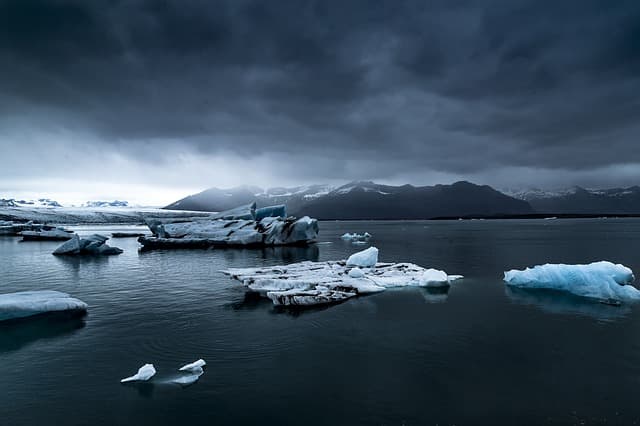
The straightforward historical answer is that Hrafna-Flóki saw a fjord full of drift ice during a hard winter and named the island after that. There is no evidence in the sagas that the name was chosen to describe the whole country's climate or landscape, Iceland is, after all, considerably greener and milder than its name suggests, especially along the south and west coasts in summer.
A popular travel legend fills that gap with a more deliberate motive: that early settlers deliberately picked a discouraging name, "Iceland", to keep newcomers away from the good land they'd already found, while reserving the friendlier name "Greenland" for a much icier island further west. It's a fun story and widely repeated, but it isn't part of the historical record in Landnámabók. The genuinely documented account is Flóki's winter on the ice-filled fjord. Whether or not the trick theory has any truth to it, it says something about how differently visitors experience Iceland once they see it for themselves, something many self-drive travellers notice within a day or two on the road.
When was Iceland actually named?
The naming happened in stages during the 9th century, before formal settlement began. Naddoddur and Garðar Svavarsson's names came first, likely in the 860s, and Hrafna-Flóki's naming of "Ísland" followed not long after, probably in the 860s or early 870s, shortly before Ingólfur Arnarson's permanent settlement around 874 AD. Because these events predate reliable written records by roughly two centuries, Landnámabók and Íslendingabók were compiled later, drawing on oral tradition, exact dates are approximate rather than fixed.
Retracing Hrafna-Flóki's route today
If the story appeals to you, the Westfjords are still one of the more rewarding, less-crowded parts of Iceland to explore by rental car, and you can get a feel for the landscape that gave the island its name. The Vatnsfjörður nature reserve, not far from where Flóki is said to have wintered, combines birch woodland in the lowlands with a landscape visibly shaped by ice-age glaciers, a good stop if you want the scenery without needing an F-road detour.
A few practical points for planning that leg of the trip:
- The Westfjords involve narrower, winding roads and longer distances between fuel and services than the Ring Road, so build in extra time.
- Weather can shift quickly, especially outside summer, check current conditions with the Icelandic Met Office (vedur.is) and road status via the Icelandic Road Administration (umferdin.is before setting out.
- A 4x4 rental is worth considering for this region outside the summer months, and if you're travelling in winter, it's worth reading up on driving in Iceland in winter before you go.
- Natural geothermal springs are scattered through the Westfjords and make a good end to a day of driving in Flóki's footsteps.
If you're building an itinerary that includes this part of the country, our Icelandic culture blog and the canyon hikes guide cover other stops worth folding into the same trip. And when it comes to choosing a vehicle for mixed terrain, tarmac, gravel, and the odd unpaved stretch, our full car lineup makes it easier to match the car to the route rather than the other way around.
Mistakes to avoid when telling (or believing) the story
- Treating the "settlers tricked each other" version as historical fact, it's a popular legend, not something recorded in Landnámabók.
- Assuming Hrafna-Flóki was the first Norseman to see Iceland, Naddoddur and Garðar Svavarsson both arrived earlier.
- Confusing the naming of Iceland with the founding of its first settlement, those are two different events, roughly a few years apart.
- Underestimating how different the Westfjords feel to drive compared with the Ring Road, plan extra time and check conditions rather than assuming it's a quick detour.
 HOW BLUE CAR RENTAL SUPPORTS LOCAL COMMUNITIES IN ICELAND