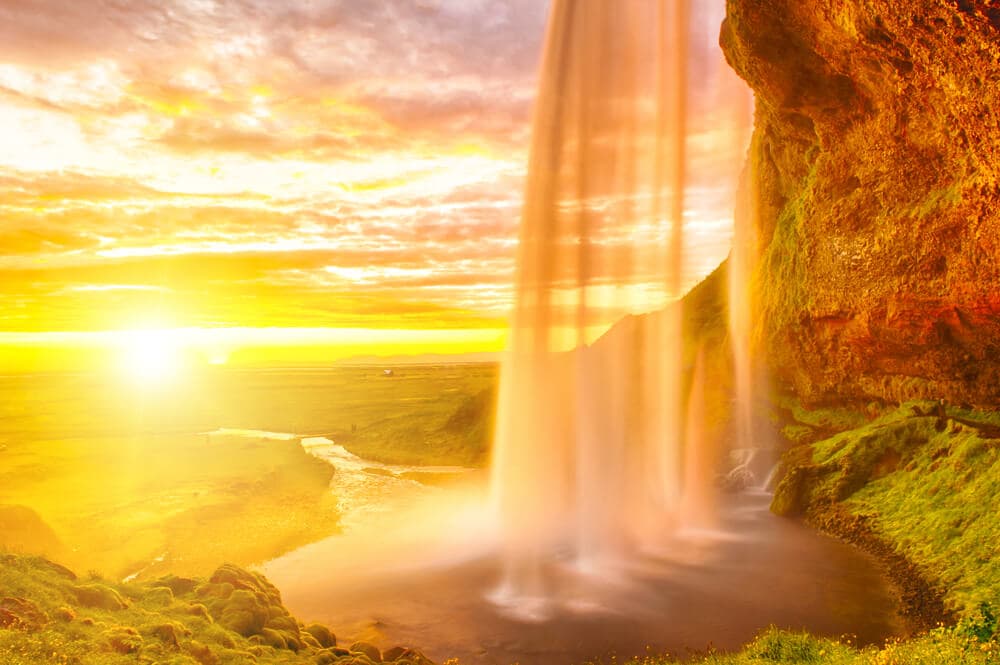

The midnight sun is the summer phenomenon where the sky in Iceland never truly goes dark, because the country sits close enough to the Arctic Circle that the sun barely dips below the horizon in the weeks around the summer solstice. It matters for trip planning because it changes how you drive, sightsee, and rest on a self-drive holiday, daylight stops being the limiting factor, but sleep and road conditions still are.
Quick answer: when is the midnight sun in Iceland?
The summer solstice falls on 21 June, the longest day of the year in Iceland. On that date, the sun rises around 03:00 and sets close to midnight, leaving only about three hours where it dips below the horizon, and even then, it stays as twilight rather than true darkness. The effect is strongest for a few weeks either side of the solstice, roughly through June and into July, and fades gradually as the nights lengthen again toward August.
What exactly is the midnight sun?
The midnight sun happens because Iceland sits at a high northern latitude, close to the Arctic Circle, where the sun's angle in summer keeps it above (or just barely below) the horizon for extended periods. Around the summer solstice, the sun doesn't sink far enough to produce a real night, the sky stays lit in soft golden or blue tones even at 1 or 2 in the morning.
This is different from the true midnight sun experienced above the Arctic Circle itself, where the sun never sets at all for a stretch of days. In most of Iceland, including Reykjavik, the sun does dip below the horizon briefly, but the twilight is bright enough that it rarely feels like nighttime. Locations further north, such as the Westfjords or around Akureyri, sit closer to the Arctic Circle and experience an even shorter, softer twilight window.
How long does the midnight sun period last?
There isn't a single hard start and end date, the effect builds gradually. Daylight lengthens through spring, peaks at the summer solstice on 21 June, and then contracts again through the following weeks. Travellers visiting anytime from late May through late July will typically experience some version of the midnight sun, with the solstice itself marking the most extreme point.
Because the seasonal shift in Iceland is fast, someone visiting in early May will still see noticeably shorter nights than in April, while someone arriving in August will notice the darkness starting to creep back in. If your travel dates matter to you specifically for the midnight sun, aim for the fortnight surrounding 21 June for the most reliable effect.
Summer solstice snapshot: what to expect around 21 June
| Detail | What happens |
|---|---|
| Date | 21 June (summer solstice, longest day of the year) |
| Sunrise | Around 03:00 |
| Sunset | Around midnight |
| Time below horizon | Roughly 3 hours |
| Darkness level | Twilight only, the sky stays bright, not fully dark |
| Effect strongest | Late May through mid-July |
| Effect fading | From late July into August |
These figures apply to Iceland generally around the solstice; exact sunrise and sunset times shift slightly by location and by the day, so treat this as a general picture rather than a precise timetable for your travel dates.
Where to experience the midnight sun in Iceland
Almost anywhere in Iceland works for experiencing the midnight sun, but the setting changes what it feels like:
- Reykjavik, bright, calm nights make it easy to walk the harbour or the city centre well past 11pm without needing a torch. It's the simplest place to experience the phenomenon without any extra driving.
- Snæfellsnes Peninsula, dramatic coastal light over Kirkjufell and the surrounding lava fields makes this a favourite for photographers doing a self-drive loop.
- The Ring Road (Route 1), driving sections of the Ring Road in the evening light means you can cover ground later in the day without racing the sunset, which is worth building into a summer road trip itinerary.
- The Westfjords and areas near Akureyri, sitting closer to the Arctic Circle, these regions get an even shorter dip below the horizon, and the light over the fjords in the small hours is one of the quieter midnight sun experiences.
For a broader sense of where the light shows up best, our roundup of Iceland's natural wonders covers many of the same spots worth timing around long summer evenings.
Best things to do under the midnight sun
Long daylight hours open up options that simply don't exist in winter. A few worth planning around:
- Late hiking or canyon walks. Trails that would normally need an early start can be tackled in the evening instead, when temperatures are cooler and the light is softer. Our guide to hiking Iceland's canyons is a good starting point if you want to build this into a summer itinerary.
- Evening photography. The low, golden light around 10pm to midnight is often more flattering than the flat light of midday, especially along the coast or on Snæfellsnes.
- Flexible driving days. Because it never really gets dark, you're not boxed into finishing your driving before sunset the way you would be in October or November. That said, comfort and legal considerations still apply, see the notes on fatigue below.
- A slower pace overall. Many travellers use the extra daylight to fit in one more stop, or simply to sit outside later without needing a headlamp. Long bright evenings near lakes and rivers coincide with peak midge activity in parts of the country, and our note on biting midges in Iceland covers when and where this is worth planning around.
If you're planning a longer warm-weather trip, our summer road trip guide has more on pacing an itinerary around Iceland's short but intense summer season.
Self-drive tips for midnight sun road trips
Endless daylight is a genuine advantage for a self-drive trip, but it comes with a few practical adjustments:
Fatigue matters more than darkness does. Because it's bright at 11pm, it's easy to keep driving longer than planned. Build in real stopping points and don't let the daylight talk you into an extra two hours behind the wheel after a long day.
Weather is still the variable to watch, not light. Iceland's summer weather can shift quickly regardless of how bright it looks outside. Check road conditions at umferdin.is (Vegagerðin) and forecasts at vedur.is (the Icelandic Met Office) before longer drives, the same way you would at any time of year.
Vehicle choice still depends on your route, not the season's daylight. Good light doesn't change whether a road requires a 4x4, F-roads into the highlands are only open for a limited summer window and still require appropriate vehicles. Their opening dates vary year to year depending on snowmelt and conditions, even though the midnight sun period itself is predictable, so always confirm current status on umferdin.is before heading into the highlands. Our guide to F-roads and the highlands and the breakdown of when a 2WD is enough versus when it isn't are worth reading before you book.
Sleep takes some getting used to. Hotel curtains in Iceland are generally designed for this, but if you're sensitive to light, pack an eye mask, it makes a bigger difference to sleep quality than anything else on this list.
Parking in Reykjavik works the same regardless of daylight. If your evenings involve driving into the city centre for dinner or a walk along the harbour, it helps to know the zone system in advance, see our Reykjavik parking guide.
If you're arriving into Keflavik for a summer trip, picking up your car is generally straightforward with online check-in, and choosing from the available vehicle options ahead of time means you're not deciding on the spot after a long flight.
 CAN YOU DRINK TAP WATER IN ICELAND?