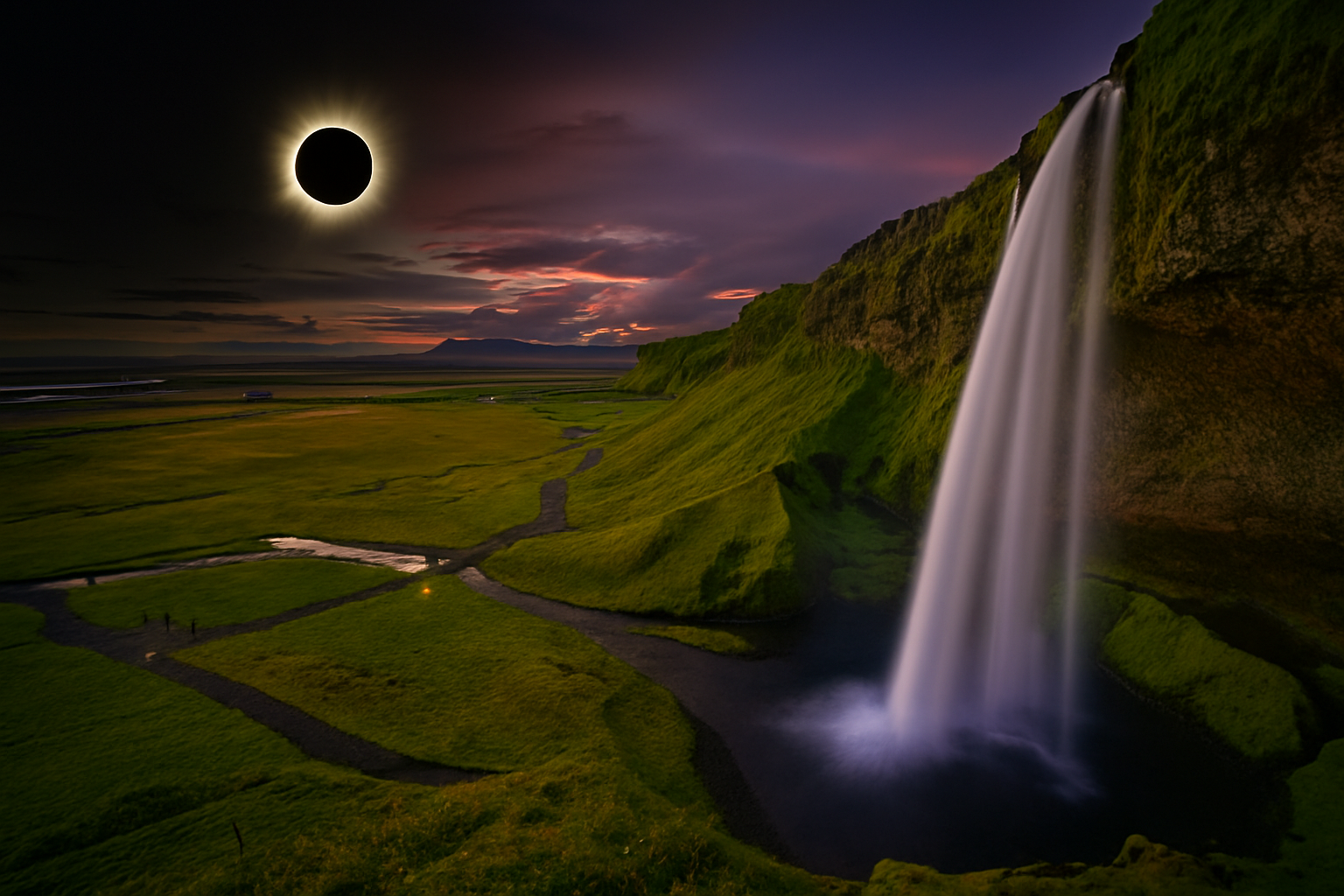

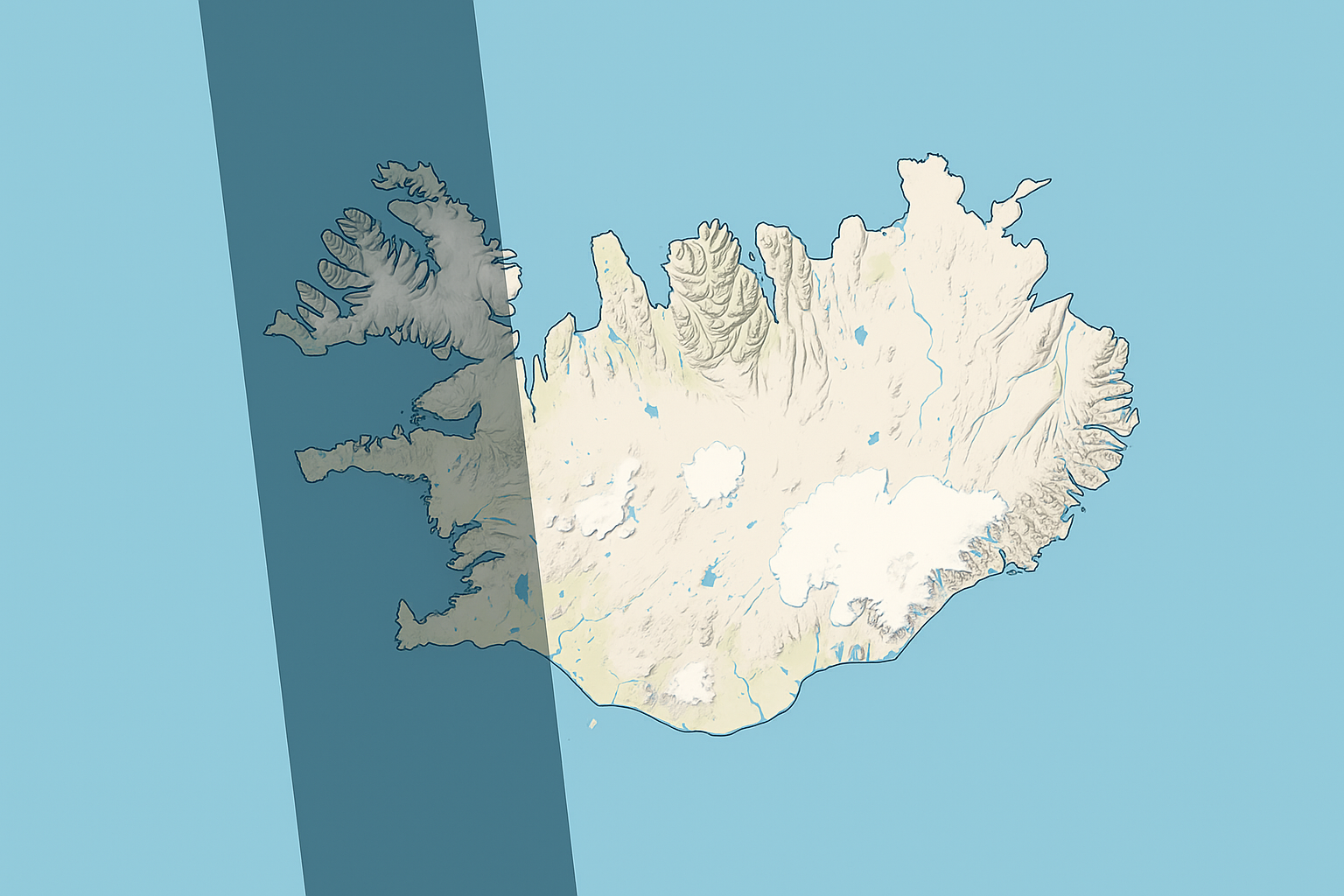
On Wednesday 12 August 2026, the Moon's shadow crosses western Iceland. According to the Icelandic Met Office, the partial phase begins at 16:42 in the northern Westfjords and ends at 18:48 on the southern tip of Reykjanes. Totality itself starts in the Westfjords at 17:44 and leaves Reykjanes at 17:49 — the shadow crosses the whole country in five minutes, travelling at 945 metres per second, or about 3,400 km/h.
This is the thirteenth total solar eclipse over Iceland since the country was settled in the late 800s, and the first since 1954. For Reykjavík it is rarer still: according to the Met Office's review of Icelandic sources, the only total eclipse ever seen from Reykjavík since settlement was on 17 June 1433 — and before that you have to go back to 118 BC. After this one, the wait is 170 years: the next is 26 June 2196.
If you are reading this in the final days before the eclipse, the thing that has changed most since we first published this guide is not the astronomy. It is the roads. Iceland's Road and Coastal Administration has published binding traffic-management measures for eclipse day — one-way systems on named roads, one full closure replaced by shuttle buses, and street closures across the capital from 15:00 to 20:00. Some places that were sensible viewing recommendations a year ago are now closed.
Around 80,000 travellers are expected in the country for the eclipse, on top of what is already Iceland's busiest tourism month. Icelandic astronomer Sævar Helgi Bragason, who has led much of the public preparation for the eclipse, treated the partial eclipse of August 2025 as a dress rehearsal for this and has urged municipalities, the road administration, civil protection and police to plan for the numbers — while warning travellers that spontaneous decisions on the day will not work. This guide is written for the person who will be behind the wheel.
Last updated: 4 August 2026. Times and historical figures are from the Icelandic Met Office report VÍ 2026-003, Sólmyrkvar á Íslandi by Þórður Arason. Road measures follow Vegagerðin, Safetravel, Ísland.is and Visit West Iceland. Re-check umferdin.is on the morning itself.
The short version
| Question | Answer |
|---|---|
| Date | Wednesday 12 August 2026 |
| Partial phase, nationally | 16:42 (N Westfjords) to 18:48 (S Reykjanes) |
| Partial phase, capital area | About 16:47 to 18:47 |
| Totality | 17:44 (Westfjords) to 17:49 (Reykjanes) |
| Longest totality on land | 2 min 13 s at Látrabjarg, Westfjords |
| Reykjavík totality | 17:48:12 to 17:49:18 — about 66 seconds |
| Where to look | West-southwest, Sun about 25° above the horizon |
| Shadow speed over Iceland | 945 m/s (about 3,400 km/h) |
| Time zone | Iceland is on GMT all year — local time = UTC |
| Traffic management starts | 08:00 on 12 August |
| Capital street closures | 15:00 to 20:00 |
| Historic clear-sky odds | Roughly 25% at that hour in August |
| Emergency number | 112 · health advice 1700 |
Because Iceland never changes its clocks, there is no summer-time offset to argue about — the times above are both local time and UTC. If that seems suspiciously convenient, we wrote about why Icelandic clocks never change.
The single most important thing to understand: you must be inside the path of totality. A 99% partial eclipse is not "almost" a total eclipse — it is a completely different event. Only inside the path do you see the corona, the planets and the 360° sunset. Everything else in this guide is secondary to that one fact.
Where and when: totality by location
Totality timing shifts by seconds over a few kilometres, so treat the table below as accurate to the minute and no finer. If you have settled on a precise spot, run its coordinates through a per-location eclipse calculator such as Time and Date the night before.
| Location | Totality (approx.) | Duration (approx.) | Notes for drivers |
|---|---|---|---|
| Straumnes / Hornstrandir | ~17:43–17:44 | ~1 min 26 s | First landfall. No road access — boat or hike only |
| Látrabjarg (Westfjords) | ~17:44 | 2 min 13 s | Longest on land. Road 612 one-way, checkpoint by 08:00, 19+1 seats max |
| Rauðisandur (Westfjords) | ~17:44 | ~2 min | Road 614 one-way from 08:00 |
| Ísafjörður (Westfjords) | ~17:44 | ~1 min 31 s | Largest Westfjords town; most services |
| Hellissandur / Rif / Ólafsvík | ~17:45–17:47 | ~2 min 9 s | Official gathering sites on the coastline. Paved access |
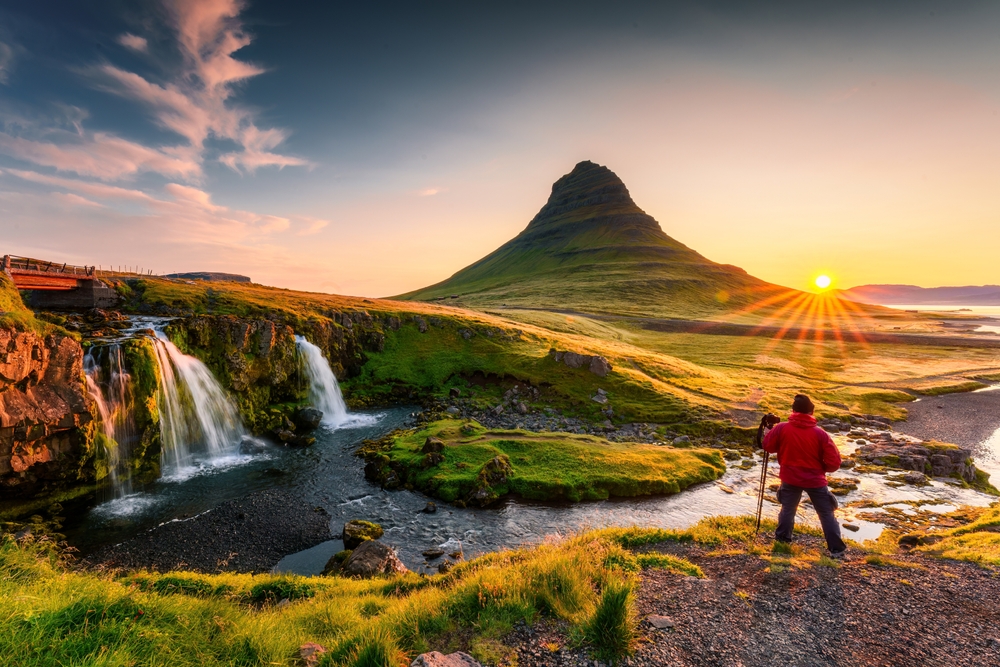
| Grundarfjörður (Kirkjufell) | ~17:46 | ~1 min 50 s | Gathering site at the Kirkjufell viewpoint |
| Stykkishólmur | ~17:46 | ~1 min | Gathering site at the football field |
| Borgarnes | ~17:47 | ~1 min | Gathering site: old town and harbour. Known bottleneck |
| Akranes | ~17:47 | ~1 min | Gathering site: Breið, by the lighthouse |
| Reykjavík | 17:48:12–17:49:18 | ~1 min 6 s | Designated areas only; streets closed 15:00–20:00 |
| Garður / Sandgerði | ~17:48 | ~1 min 40 s | Road 45 under traffic management from 08:00 |
| Reykjanestá | ~17:49 | ~1 min 50 s | Longest on Reykjanes; last mainland point the shadow touches |
| North and east Iceland | — | none | Deep partial only, around 96–98% |
Do not obsess over duration
The centre of the shadow — where totality lasts longest — is out at sea on 12 August. That means the difference between the best and worst spots inside the path is about a minute, and chasing that extra minute is usually the wrong call. As the team behind solmyrkvi2026.is put it in their list of ten mistakes to avoid, cloud cover and access matter far more than squeezing out another thirty seconds. A comfortable two minutes at Ólafsvík under a clear sky beats 2 min 13 s at Látrabjarg under cloud, at the end of a controlled gravel road, every time.
The edge-of-path trap — a genuinely local warning
As solmyrkvi2026.is points out, two inhabited areas sit agonisingly just outside the path, by less than a kilometre: Hvanneyri and Mosfellsdalur. The westernmost house at Hvanneyri is roughly 600 metres outside the line of totality. If you are staying at Hvanneyri, in Mosfellsdalur, or around Meðalfellsvatn and Kjós, you need to move only slightly west — but you absolutely must move. Stay put and you will watch a 99.9% partial eclipse and miss the corona entirely, which is the kind of near-miss people do not forgive themselves for.
The Sun will be low
At totality the Sun sits about 25° above the horizon in the west-southwest. That one fact should drive your choice of spot more than the view or the scenery: a headland, a hill or a west-facing shoreline beats a pretty valley. Anything tall on your western side — a ridge, a warehouse, a stand of trees — will hide the corona at the exact moment it appears. Walk your chosen spot the day before and physically look west-southwest.
Eclipse day on the roads
This is the section that did not exist a year ago, and it is now the most important one. Traffic management on state roads begins at 08:00 on 12 August and continues through the event. Police have said they intend to remove illegally parked vehicles.
Snæfellsnes
| Road | Measure |
|---|---|
| Útnesvegur (574) | One-way traffic, Búðir → Hellissandur, from 08:00 |
| Öndverðarnesvegur (579) | Closed to general traffic. Shuttle buses run instead, operated by Snæfellsjökull National Park |
A one-way system means what it says: once you commit to Útnesvegur heading west, you are not turning round to chase a gap in the cloud. Choose your side of the peninsula in the morning, not at 17:00.
Westfjords
| Road | Measure |
|---|---|
| Örlygshafnarvegur (612) — to Látrabjarg | One-way. Checkpoint must be cleared no later than 08:00. Vehicles up to 19+1 seats only; larger coaches refused. 60 km/h to Breiðavík, then 50 km/h to Látrabjarg. No parking on the roadway or shoulders — illegally parked vehicles removed |
| Rauðasandsvegur (614) | One-way from 08:00 |
Látrabjarg has the longest totality in the country and the tightest access rules on the island. If Látrabjarg is your plan, you are making a pre-dawn start. One caveat worth knowing: the cliffs are famous for puffins, but most have usually left for the open sea by mid-August, so do not count on them as a consolation prize.
Dalabyggð
| Road | Measure |
|---|---|
| Klofningsvegur (590) | One-way: Hvammsveit → Fellsströnd → Skarðsströnd → Saurbær, from 08:00 |
Reykjanes Peninsula
| Road | Measure |
|---|---|
| Garðskagavegur (45) | Traffic management, Nesvegur → Sandgerði, from 08:00 |
| Vatnsleysustrandarvegur (420) | Traffic management, Vogar → Kúagerði, from 08:00 |
Capital area — closed 15:00 to 20:00
| Location | Measure | Where to park |
|---|---|---|
| Seltjarnarnes, Suðurströnd | Closed to motor vehicles, from the Vivaldi sports field and pool at the east end and at Lindarbraut/Nesbali at the west | Pool car park, Austurströnd, Eiðistorg |
| Seltjarnarnes, Norðurströnd | Closed west of Lindarbraut | Austurströnd, Eiðistorg |
| Grótta | Access not permitted on 12 August. Road closed 15:00–20:00 — high tide falls during the eclipse | — |
| Reykjavík, Ægisíða | Closed to motor vehicles | Walk, cycle or take the bus |
| Reykjavík, Suðurgata | Closed to motor vehicles from Hringbraut | Walk, cycle or take the bus |
| Garðabær, Álftanes | One-way on Álftanesvegur and Suðurnesvegur | Sports centre and pool, plus the fields to the west |
Note the Grótta line carefully. Grótta lighthouse is the classic Reykjavík sunset spot and it appeared in the earlier version of this guide. It is not available on eclipse day. The designated capital-area viewing areas are Ægisíða, Seltjarnarnes (Suðurströnd), the Álftanes shoreline, and the Hamarinn and Ástjörn car parks in Hafnarfjörður.
If you are staying in Reykjavík, the honest advice is to leave the car at the apartment. The designated areas are all reachable on foot, by bike or on a Strætó bus, the surrounding streets are closed for five hours, and you will spend the difference in parking frustration. Our Reykjavík parking guide covers the city's zone system for the rest of your trip.
Official gathering sites (söfnunarstaðir)
West Iceland has set up managed sites with toilets and basic facilities: Akranes (Breið, by the lighthouse), Borgarnes (old town and harbour), Stykkishólmur (football field), Grundarfjörður (Kirkjufell viewpoint), Ólafsvík, Rif and Hellissandur (coastline). Each has parking, but capacity is limited. Do not stop on road shoulders — beyond the removal risk, a car on a verge on a single-lane rural road is a genuine obstruction for ambulances.
Expect bottlenecks at Borgarnes and around Reykjavík, both before and after the eclipse. Borgarnes is the funnel for everything coming down from Snæfellsnes and the Westfjords, and there is no alternative route.
The cloud gamble, honestly
Iceland in August is cloudy. Historically, 12 August has been overcast 70–80% of the time, and twenty years of Met Office data put the chance of clear or partly clear skies at that hour in August at roughly 25%. West-coast odds run a little better; Reykjavík on any given afternoon is nearer 15–20%.
Those numbers sound bleak, and it is better to know them now than to discover them on the day. Three things soften them.
Iceland is often cloudy and rarely completely overcast. Cloud over land is convective, broken up by terrain and daytime heating, so gaps genuinely move around. A 25% station-level statistic is not a 25% chance that the whole west coast is socked in.
There is a precedent, with a caveat. During the annular eclipse of 31 May 2003 it was overcast across almost the entire country, and the eclipse was still clearly visible between the clouds in the north-west. Be honest about the limits of that comparison: 2003 was an annular eclipse at sunrise, around 04:05, not a total eclipse on an August evening. It shows that broken Icelandic cloud is not automatically a write-off — it does not promise you a gap.
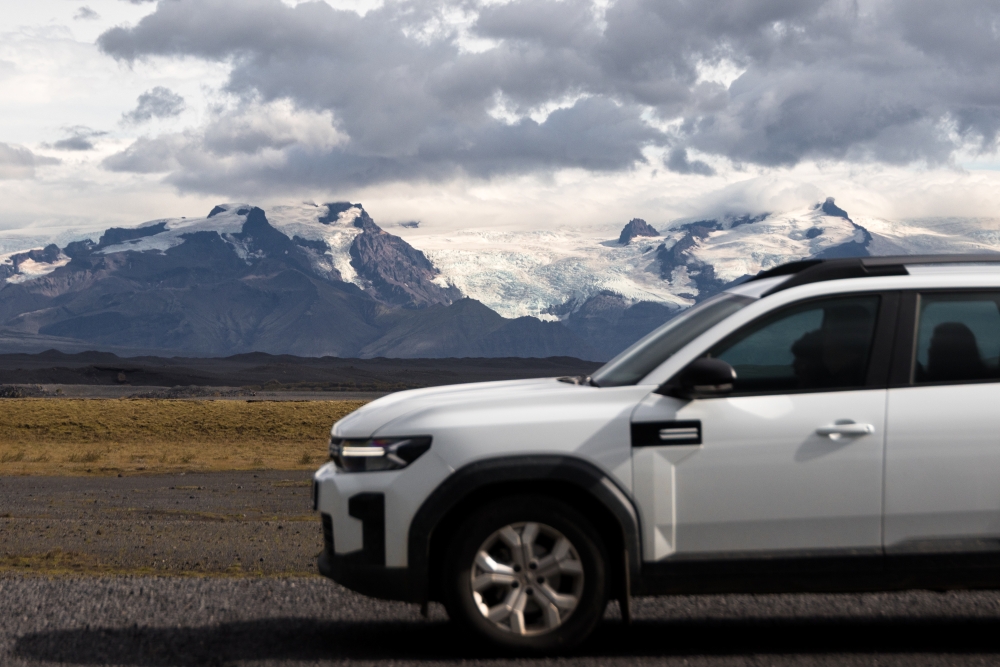
A car is the best eclipse instrument you can rent — for the morning, not the moment. We should be precise about this, because we rent cars and you should be able to weigh our advice accordingly. A car does not help you in the final hour: by then you are inside a one-way system, and driving during totality is both dangerous and pointless. What a car does is let you choose, at breakfast, which coast you stand on. That is the whole of its value on eclipse day, and it is genuinely worth a lot. On the day:
- Check the cloud forecast at breakfast — vedur.is for the high-resolution cloud layer rather than the general symbol forecast.
- Commit by mid-morning. Traffic management starts at 08:00 and one-way systems bite well before noon. The window for a real repositioning decision closes early.
- Prefer coasts and headlands to valleys. They give you both the low western horizon you need and a better chance of a break.
- Do not plan to chase at 17:00. You will be on a one-way road in a queue, watching totality through a windscreen — a bad view and a dangerous one.
And a point worth making plainly: even under cloud, totality is worth being outside for. The light goes wrong in a way no photograph conveys, the temperature drops, birds fall silent, and the horizon lights up in a 360° false sunset. Cloud takes the corona; it does not take the experience.
For the wider picture on what an Icelandic August actually does, see our month-by-month guide to Iceland in August.
Plan ahead: the things that are already gone
August is normally Iceland's single biggest month for tourism. The eclipse has landed on top of that, and the strain is real enough that Icelandic economists have publicly debated its effect on national inflation figures. For you, it shows up as sold-out rooms and surge prices. Let us be blunt about it.
Hotels and guesthouses in the path are gone. Most accommodation in West Iceland and the Westfjords has been fully booked for a long time — in many cases well over a year. Reykjavík room rates around 11–12 August have been running at multiples of the normal August price. Our guide to whether Iceland is expensive is calibrated for a normal summer, not this week.
Restaurants in the path are effectively fully booked. Ólafsvík, Grundarfjörður, Stykkishólmur and Borgarnes have a handful of restaurants between them, sized for a normal Icelandic summer, not a national event. If you have not reserved, do not assume you will eat out on 12 August. Two practical moves:
- Phone the restaurant directly rather than using an international booking platform. Small Icelandic places often hold tables back from the platforms, and a call at 10:00 is worth more than a form submission.
- Provision from a supermarket instead, and treat that as the plan rather than the fallback. Bónus, Krónan and Nettó are all far cheaper than eating out — our supermarket guide covers the chains and opening hours, and here are Icelandic foods worth eating on the road. Shop in Reykjavík or Borgarnes, not in a village of 500 people on the morning of the eclipse.
Campsites do not take bookings. Most West Iceland campsites run first-come, first-served with no reservation system, so the only way to secure a pitch is to arrive early — the day before, ideally. Sleeping in a campervan outside an organised campsite is generally not permitted without explicit landowner permission, and eclipse week is the worst imaginable time to test that. Our camping guide covers the etiquette and the facilities to expect.
Fuel up the day before. Fill the tank or charge the battery before you drive to your viewing location. Rural stations are small, they will queue, and petrol stations and road cafés along the route will be swamped. See our refuelling guide and current fuel prices.
Toilets are the underrated problem. Facilities exist at the official gathering sites and are limited to non-existent elsewhere. If you are heading to a remote headland, plan accordingly.
Download your maps. Mobile coverage on the outer Snæfellsnes and Westfjords roads is patchy at the best of times, and tens of thousands of phones in one valley will not improve it. Cache the area offline before you leave — our Google Maps in Iceland guide shows how, and a paper map in the glovebox costs nothing.
Consider not driving at all. The path covers the Westfjords, West Iceland, the capital region and Reykjanes — which means roughly 70% of Iceland's population can see this from home. Ísland.is makes the same point: in much of western Iceland you can experience the eclipse from where you already are. If your accommodation is inside the path and has a clear west-southwest horizon, the best plan may be to walk outside and stay there. That is not a contradiction of the point above: use the car to get to the right region and to make the morning weather call, then park it and stay on foot for the eclipse itself.
Where the authorities have been asked for one sentence, it has consistently been: arrive early, stay late, come prepared.
Two itineraries that still work
Both of these assume you already have a car and a bed. They are built around the road restrictions rather than ignoring them.
West Coast Explorer — 5 to 6 days
- Day 1 — arrive. Land at Keflavík, collect the car, drive to Reykjavík. Buy your eclipse glasses today if you do not already have them.
- Day 2 — Snæfellsnes. Drive up via Borgarnes. Ytri-Tunga seal colony on the south side, then Arnarstapi and Búðir. Sleep on the peninsula, ideally at Ólafsvík, Rif or Hellissandur.
- Day 3 — scout and settle. Walk your chosen viewing spot and check the western horizon in person. Vatnshellir lava cave (an 8,000-year-old lava tube) is a good weather-proof option if it rains. Shop for eclipse-day food today.
- Day 4 — eclipse day. Follow the timeline below. Remember Útnesvegur (574) is one-way from 08:00 and Öndverðarnesvegur (579) is closed to cars.
- Day 5–6 — Westfjords or home. Either take the Breiðafjörður ferry or drive north for Dynjandi waterfall and Rauðasandur beach, or return via Borgarnes at a civilised hour once the traffic has cleared.
Capital and Reykjanes mini-break — 3 days
- Day 1 — Reykjavík. City on foot. Confirm which designated viewing area you will use, and how you will get there without a car.
- Day 2 — Reykjanes. Gunnuhver geothermal field, the Bridge Between Continents, Brimketill lava rock pool, Garðskagi lighthouse. Note that Road 45 and Road 420 come under traffic management tomorrow from 08:00.
- Day 3 — eclipse day. Either stay in the capital and walk to Ægisíða or Seltjarnarnes, or position early on Reykjanes at Garður or Sandgerði. Do not attempt both.
A note on the Blue Lagoon and the Fagradalsfjall area: both featured in the earlier version of this guide, and both are worth checking directly before you plan around them. The Blue Lagoon is running its own eclipse arrangements and books out, and access around the Sundhnúkur and Grindavík volcanic zone changes with the activity. Check safetravel.is on the day rather than trusting any guide, including this one.
An eclipse-day timeline that works
| Time | What to be doing |
|---|---|
| 07:00 | Check the vedur.is cloud forecast and umferdin.is. Make your call and commit |
| before 08:00 | If Látrabjarg is the plan, you must be through the Road 612 checkpoint |
| 08:00 | Traffic management live on all named roads |
| 08:00–11:00 | Drive. Fuel up en route, buy food, use real toilets |
| by 14:00 | Be at your viewing area. Officials suggest 2–3 hours before the partial phase |
| 15:00 | Capital-area street closures begin |
| 16:42–16:47 | Partial phase begins. Glasses on — and only for looking at the Sun |
| 17:30 | Light starts to feel wrong. Temperature drops. Put the phone down |
| ~17:44–17:49 | Totality. Glasses OFF during totality only. Look up, then look around |
| +1 min | Glasses back on the instant the first sliver returns |
| 18:47–18:48 | Partial phase ends |
| 18:48–20:30 | Do not leave yet. Eat, walk, let the queue drain |
| 20:00 | Capital closures lift |
Two rows deserve emphasis. The eclipse lasts about two hours, not two minutes — arriving at 17:40 means missing most of it, and the slow bite of the partial phase is part of the experience. And the last row is the one most visitors get wrong. Staying put for an hour or two afterwards is explicitly what the authorities have asked for, and it is in your own interest: it keeps roads clear for emergency services, and it means you are not sitting in a stationary queue on a gravel shoulder at dusk. You will be in traffic either way — better to be in it after a coffee than instead of one.
What to bring
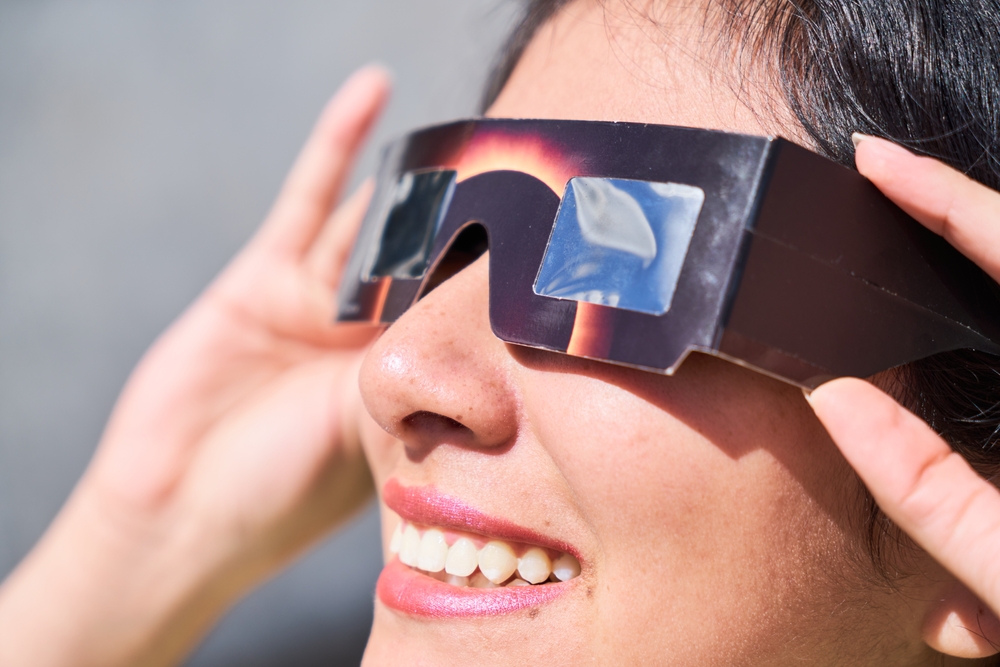
- Certified eclipse glasses, one pair per person. They must meet EN ISO 12312-2:2015 and carry a CE mark. Ordinary sunglasses are not eclipse glasses and never will be. Buy from a certified supplier, and buy before you arrive — do not count on finding them in a village shop on the day.
- Inspect the glasses before use. The Directorate of Health specifically warns against torn or scratched filters, and against counterfeit products from unknown makers.
- A proper solar filter for any camera, phone lens, binoculars or telescope. Unfiltered optics concentrate sunlight and will damage both the sensor and your eye.
- Warm, waterproof layers. It is August, it is a windy north-Atlantic coast, and you will stand still for three hours. Our summer packing guide is calibrated for exactly this mismatch.
- Food and water for several hours, plus any medication you need.
- A full tank or full charge.
- Offline maps and a paper backup.
- A power bank. Cold, heavy camera use and weak signal drain phones fast.
- A bin bag. Pack out everything, including at the gathering sites.
Safety and etiquette
Your eyes. Never look at the Sun without certified glasses during the partial phases. The Directorate of Health makes a point that is easy to miss: as the light dims, it feels safer, and that false sense of safety is exactly when people get hurt. Supervise children closely throughout.
During totality — and only during totality — take the glasses off. This is not optional advice: if you leave them on, you will not see the corona at all. Roughly two minutes in western Iceland, roughly one minute in the capital region. The moment the first bright sliver reappears, glasses go straight back on.
Driving. Do not drive during totality. Pull into a designated area well beforehand and stay there. Iceland's speed limits are low for good reason: 50 km/h in built-up areas, 80 on gravel, 90 on paved rural roads. Headlights are mandatory day and night, seatbelts are mandatory for everyone, and single-lane bridges belong to whoever arrives first. Our road rules guide has the details, and what to do in an emergency is worth five minutes before you set off.
Off-road driving is illegal in Iceland. Not discouraged — illegal, with real fines, and damage to moss and lava that lasts decades. Eclipse day will produce a strong temptation to pull onto a verge or across a field for a better angle. Don't. Here is why off-road driving carries the penalties it does. The same goes for the F-roads — highland routes need a suitably equipped 4×4, and none of them are on the way to totality.
No drones during the eclipse. This has been stated explicitly.
Emergencies: 112. Non-urgent health advice: 1700. Roads: umferdin.is. Weather: vedur.is.
What to actually look at (including the bit people forget)
For the hour beforehand, the light turns metallic and slightly wrong — sharper shadows, a silvery cast on sea and land that your brain cannot place. The temperature falls. Birds go quiet. In the last seconds before totality, sunlight streaming through valleys on the Moon's edge breaks into a line of bright points, Baily's beads, which collapse into a single brilliant flare: the diamond ring.
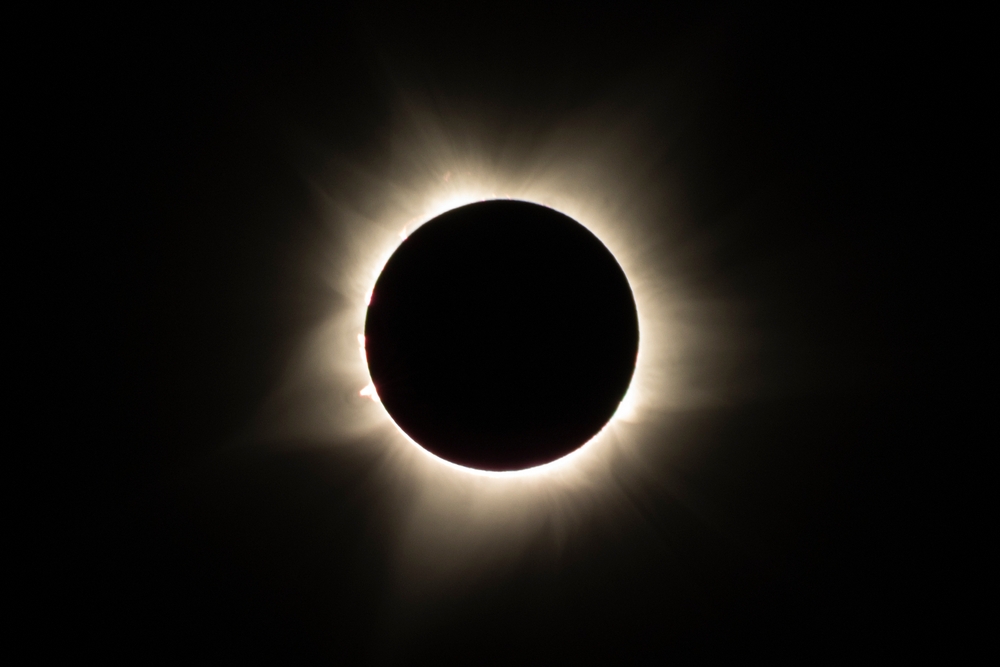
Then it goes, and the corona appears — a pale, structured halo, visibly streaked along the Sun's magnetic field rather than a smooth glow.
Now look away from the Sun. This is the mistake almost everyone makes. If the sky is clear you will see, alongside the eclipsed Sun about 25° up in the west-southwest:
- Venus, brilliant, to the left of the Sun
- Jupiter, bright, to the right
- Mercury, much fainter, near Jupiter
- A 360° band of sunset orange all the way round the horizon — because you are standing inside a shadow only about 100 km wide, looking out at daylight beyond its edge
And put the camera down. One to two minutes is not long. If you want photographs, automate the sequence and rehearse it beforehand; if you are using a phone, set it to record and then physically put it down. Do not spend the corona watching a small screen. The strong advice from experienced eclipse-chasers is to spend the first half looking up and the second half looking around — and to experience it with your own eyes rather than through a viewfinder.
In Reykjavík you get sixty-six seconds of this. At Látrabjarg, a little over two minutes. Either way it ends before you feel ready.
A little history, because Iceland has waited a while
The Met Office's review of Icelandic sources counts thirteen total solar eclipses over Iceland since settlement, alongside sixteen annular ones. Across the last two centuries there have been only three: 1833, 1851 and 1954.
For the capital specifically the numbers are startling. The eclipse of 17 June 1433 is the only total eclipse seen from Reykjavík since settlement — and the one before that was in 118 BC. Over the three thousand years from AD 1 to AD 3000 there are just three total eclipses at Reykjavík, against nine at Hraunhafnartangi in the north-east. Totality is not distributed fairly, and the capital has had a very thin share of it.
Iceland has also had its near-misses on record. During the eclipse of 29 October 878, the settlement farm in Kvosin — the hollow that is now central Reykjavík — sat about 7 km outside the path of totality and saw more than 99.9% obscuration instead. That is the same trap described above at Hvanneyri and Mosfellsdalur, playing out eleven centuries earlier.
The 1954 eclipse crossed the southernmost part of the country around 12:05 on 30 June, with a maximum of 1 min 46 s over Vestmannaeyjar. Contemporary accounts describe crowds travelling from Reykjavík and beyond to Landeyjar, Eyjafjallasveit, Mýrdalur and the Westman Islands, with Icelandic and foreign scientists taking measurements. It is a neat symmetry: in 1954 the country drove south, and in 2026 it drives west.
The 1851 eclipse is stranger. No printed contemporary account of it survives, and by 1954 it had been forgotten so completely that Icelanders generally believed 1833 had been the last. It survives instead in weather journals, diaries and one remarkable memoir: Guðrún Björnsdóttir, a nineteen-year-old farm worker in Aðaldalur, recalled decades later that the ground went "ice-cold" and that she and the others stopped haymaking and went home, while the mistress of the house lit a lamp so she could see in the kitchen.
Globally, the 2026 eclipse begins in Siberia around 17:00, crosses the Arctic Ocean almost directly over the North Pole, touches eastern Greenland, crosses Iceland, then northern Spain, and ends at sunset over the Mediterranean around 18:30. Iceland gets one of the best land-based views on the entire track.
If you are outside the path
Northern and eastern Iceland see a deep partial eclipse of roughly 96–98%. The light dims noticeably and the crescent Sun through eclipse glasses is genuinely worth seeing — but it is a fundamentally different event. The corona, the planets and the 360° sunset happen only inside the path. If you are in Akureyri or Egilsstaðir hoping for darkness, it will not come.
Whether it is worth relocating depends on your appetite for a long drive into the busiest traffic day of the Icelandic year. If you were already planning a Westfjords road trip or a Snæfellsnes loop, the answer is easy. If not, weigh it honestly — and note that Kirkjufell is both a designated gathering site and one of the most photographed mountains in the country, so it will be busy.
There is also plenty to do either side of eclipse day if you are already in the west: the Westfjords essentials guide covers the long gravel days, the seal colony at Ytri-Tunga is a short detour on the south side of Snæfellsnes, and on Reykjanes the hidden gems and geothermal areas near Reykjavík make good use of 11 and 13 August, when everyone else is either arriving or leaving. For shorter options, see our short road trips from Reykjavík.
Renting the right car for eclipse week
You do not need a 4×4 to see this eclipse. Every official gathering site, and every road under traffic management, is reachable in a two-wheel-drive car. What matters more is that the car is comfortable to sit in for a long day and that you understand its fuel or charging needs.
A 4×4 is worth it if your plan involves the rougher Westfjords gravel — Road 612 to Látrabjarg is a serious gravel road and Rauðasandur is not much gentler. Our 4×4 vs 2WD guide walks through the decision honestly, and a mid-sized SUV is the usual sweet spot for a Westfjords eclipse trip.
If you would like the trip itself to be low-carbon, our electric vehicles run on a grid that is essentially all hydro and geothermal — but charge to full the night before, because rural chargers will be busy and range anxiety on top of eclipse traffic is no fun. Browse the full fleet for what is still available.
Practical points for eclipse week specifically:
- Pick up at Keflavík Airport and check our opening hours against your flight — 11 and 12 August are exceptionally busy days at the airport.
- Unlimited mileage means repositioning for weather costs you nothing but time.
- Read your insurance before eclipse day, not after. Gravel and sand-and-ash protection matter on Westfjords roads.
- 24/7 assistance on +354 773 7070. Save it in your phone before you drive out of coverage.
The nine things that matter
- Be inside the path of totality. A 99% partial eclipse is a different event. If you are at Hvanneyri, Mosfellsdalur, Meðalfellsvatn or Kjós, move slightly west.
- Totality is 17:44 to 17:49, depending where you stand. The whole eclipse runs about 16:42 to 18:48.
- Face west-southwest, about 25° up. Pick a spot with nothing tall on its western side.
- Traffic management starts at 08:00. One-way systems on Roads 574, 590, 612 and 614; Road 579 closed with shuttles; capital streets closed 15:00–20:00; Grótta is off-limits entirely.
- Decide in the morning, not at 17:00. Check vedur.is and umferdin.is at breakfast, then commit.
- Do not count on restaurants or fuel stops. Provision from a supermarket and fill the tank the day before.
- Certified glasses only — EN ISO 12312-2:2015 with a CE mark, one pair per person, inspected for scratches.
- Glasses off during totality, on the instant it ends. Otherwise you will not see the corona at all.
- Stay put for an hour or two afterwards. You will be in the queue either way.
Official sources to check on the day
- Road conditions and closures: umferdin.is — Icelandic Road and Coastal Administration
- Traffic-management detail: vegagerdin.is
- Weather and cloud forecast: vedur.is — Icelandic Met Office
- Safety guidance: safetravel.is
- Official travel advice: island.is
- Eye protection (Directorate of Health): island.is eye guidance
- West Iceland gathering sites: west.is
- Westfjords guidance: westfjords.is
- Eclipse specifics, maps and viewing sites: solmyrkvi2026.is · eclipse2026.is
- Ten mistakes to avoid on eclipse day: solmyrkvi2026.is — essential reading, and the source of the edge-of-path warning above
- Per-location times: Time and Date eclipse calculator
- Historical background: Sólmyrkvar á Íslandi, Náttúrufræðingurinn and the full Met Office report VÍ 2026-003
- Ongoing news coverage: RÚV eclipse hub · Vísir eclipse hub · visitor numbers and preparations · economic pressure on August
- Emergencies: 112 · Health advice: 1700 · Blue Car Rental 24/7: +354 773 7070
 CAN YOU DRINK TAP WATER IN ICELAND?