
Parking in Iceland is easy to get right once you understand two separate systems: the paid zones and time windows used in downtown Reykjavik, and the marked lots used at waterfalls, national parks and other attractions around the country. Getting either one wrong is usually what leads to a parking ticket.
Short answer: Reykjavik's city centre uses four paid parking zones (P1–P4), charged on weekdays in all four zones, and on Saturdays and Sundays too in the two central zones (P1 and P2); public holidays are free. You pay by app (Parka or EasyPark) or at a street machine, and the system reads your license plate rather than requiring a paper ticket. Outside the city, most attractions have designated parking areas, some free, some paid by machine or QR code, and parking on road shoulders or on moss and lava fields is not just discouraged, it can be dangerous and is best avoided entirely.
How do Reykjavik's parking zones work?
Reykjavik's city centre is divided into four numbered parking zones, P1 to P4, and the zone number is usually posted on a sign at the start of each street or lot. The lower the number, the more central, and typically the more expensive, the parking.
| Zone | Location | Relative cost | Typical availability |
|---|---|---|---|
| P1 | Innermost core: main shopping streets, Laugavegur area, harbour district | Highest | Busiest, fills up first |
| P2 | Just outside the core | Medium-high | Moderate |
| P3 | Slightly further out, mixed residential/commercial | Medium | Easier to find space |
| P4 | Outer business and residential zones | Lowest, often free outside business hours | Usually available |
Rates and exact boundaries can change, so it's worth checking the City of Reykjavik parking map or the signage on-site rather than relying on memory from a previous trip. Rates and zone boundaries last checked August 2026 via the City of Reykjavik parking map.
When do you actually have to pay?
Paid parking in Reykjavik applies:
- P1 and P2: 9:00–20:00 on weekdays, 10:00–20:00 on Saturdays and Sundays
- P3: 9:00–18:00 on weekdays
- P4: 8:00–16:00 on weekdays
- Public holidays: free in all zones
These hours follow Reykjavík's parking notice B 112/2026; from 1 October to the end of 2026 the P1 and P2 end time is 20:00 instead of 21:00 (Vísir). Last checked October 2026.
Outside these windows, parking is typically free even in the paid zones, but always check the sign at the specific spot, since some P4 areas or residential streets have their own rules or require a resident permit.
How do you pay for parking in Reykjavik?
Most visitors pay through a mobile app rather than a street machine, mainly because it's faster and lets you extend a session without walking back to the car. The two apps used across the city are:
- Parka
- EasyPark
Both are free to download, available in English, and work by linking your session to your license plate, so there's no paper ticket to display on the dashboard. You enter the zone number, select how long you need, and pay by card through the app. Street-side machines that take coins or cards are still available in most zones if you prefer not to use an app.
Whichever method you use, double-check you've selected the correct zone number before paying, a session paid for the wrong zone doesn't protect you from a ticket.
What happens if you get a parking ticket in Iceland?
A parking ticket in Iceland (usually a yellow slip left on the windshield) is not unusual for visitors who misjudge a zone or a payment window, and it's not a crisis if it happens. The slip lists the fine amount and how to pay it, typically online through a link on the ticket, or at a local bank.
If the fine is left unpaid, Blue charges the full fine amount to your credit card, along with a handling fee (Blue Car Rental FAQ), and paying within the set time frame, typically 3 days, reduces the amount. It's worth paying any ticket directly and promptly rather than letting it roll into your rental account, simply because that keeps the process, and the cost, in your hands rather than the rental company's. If you're unsure how a ticket would be handled on your booking, it's best to check the rental terms or ask directly when you pick up the car.
Where do you park at Thingvellir, Seljalandsfoss, and other attractions?
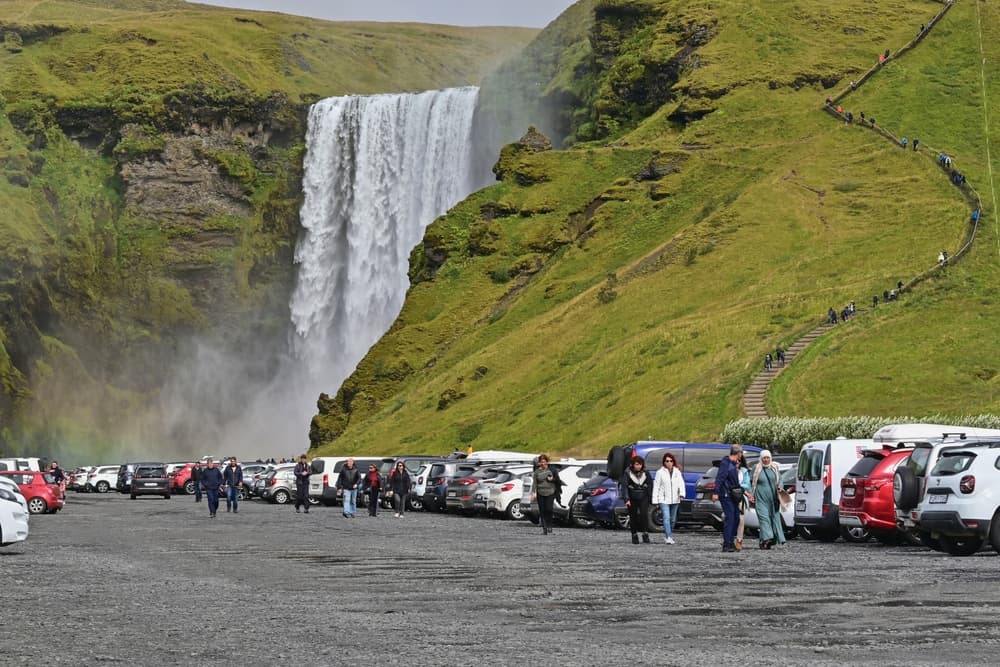
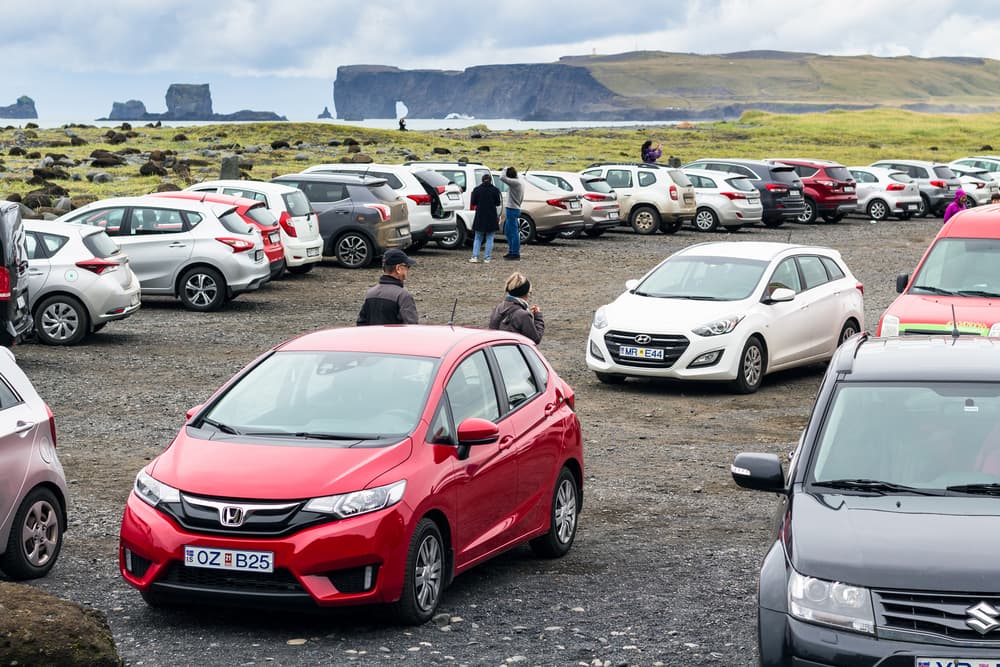
Most major attractions in Iceland have a designated parking area, and increasingly these are paid rather than free, usually through a machine on-site or a QR code payment system.
| Attraction | Parking status (typical) |
|---|---|
| Þingvellir National Park | Paid, automated machines |
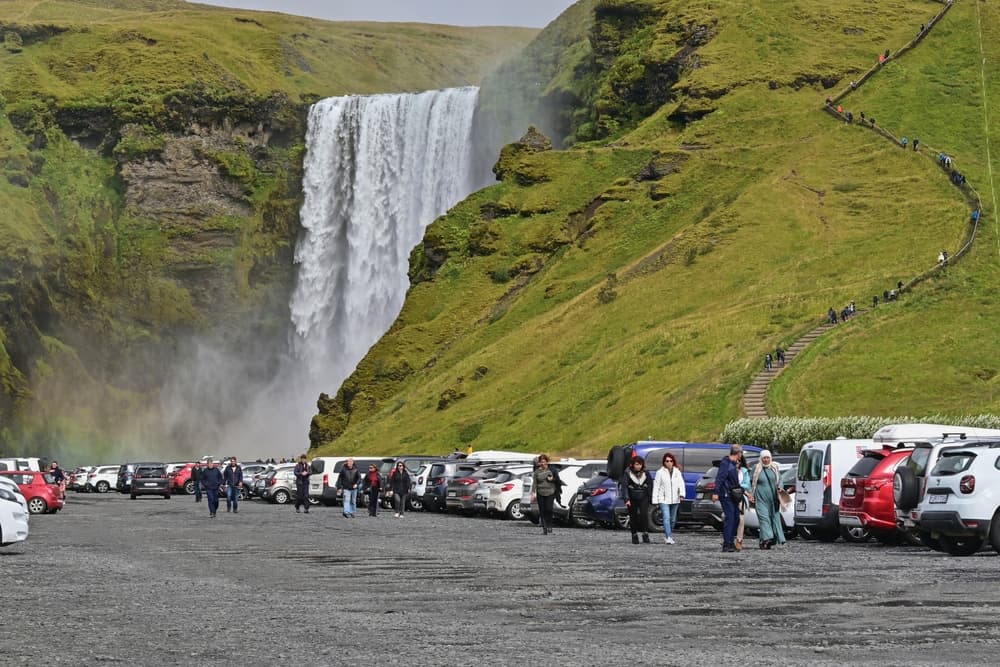
| Seljalandsfoss & Skógafoss | Paid, card or online payment |
| Geysir & Gullfoss | Paid: Geysir 1,080 ISK per car for up to 8 hours; Gullfoss upper car park (by Gullfoss Kaffi) 1,080 ISK for up to 4 hours; plate cameras, pay online via Parka within 24 hours (last checked October 2026) |
| Jökulsárlón & Diamond Beach | Paid, machine or online payment |
These fees are usually modest and go toward maintaining trails, toilets, and visitor safety infrastructure at the site. Because fee status can change between seasons and sometimes between years, treat the table above as a general guide and check signage on arrival. Fee status above last checked August 2026 via each site's signage and operator: Þingvellir National Park and Vatnajökull National Park for Jökulsárlón; on-site signage for Seljalandsfoss and Skógafoss. Always use the marked lot or pull-out rather than driving onto unmarked grass, moss, or gravel beside it, beyond the fine risk, Iceland's ground cover is slow-growing and easily damaged by tyre tracks that can last for years.
Why shouldn't you stop on the road shoulder?
You shouldn't stop on the shoulder of an Icelandic road for photos unless it's a genuine emergency, because many roads, including sections of Route 1, the Ring Road, have narrow shoulders, blind curves, and fast-moving traffic with little reaction time for other drivers. This is one of the more common causes of avoidable accidents involving rental cars.
If you need to stop:
- Use an official rest stop, pull-out, or car park, not the open shoulder
- Turn on your hazard lights if you do have to stop briefly
- Never pull onto moss, lava fields, or soft ground, both for safety and environmental reasons
This applies whether you're in a compact 2WD or a highland-capable 4x4, vehicle choice doesn't change the physics of stopping on a blind bend. If you're deciding what vehicle suits your route and season in the first place, our guide on 4x4 vs 2WD in Iceland is a useful starting point, and driving in Iceland in winter covers how conditions change the calculation between October and April.
Mistakes to avoid with parking in Iceland
A few recurring mistakes account for most parking tickets and awkward moments:
- Leaving valuables visible in the car, particularly in central Reykjavik car parks and at popular trailhead lots, where break-ins are occasional but do happen.
- Ignoring residential permit zones in parts of P3 and P4, which are off-limits to non-permit holders even when they look like ordinary street parking.
Where does Blue Car Rental fit into this?
None of this changes much depending on which company you rent from, but a few practical details make the day-to-day easier. Blue Car Rental's online check-in lets you complete paperwork before you land, so you're not doing it curbside while working out where to park at Keflavik Airport. If your trip starts in the city, Blue Car Rental's Reykjavík office at Fiskislóð 22 is open 08:00-18:00 all year, and picking up a car there costs nothing extra. It's a short walk from the Miðbakki pier and about a 10-minute drive from the Skarfabakki cruise pier, which helps if you're arriving by ship. The fleet, from small 2WD city cars to 4x4s built for highland routes, is outlined on the our cars page if you're still deciding what suits your itinerary, and every rental includes CDW, SCDW, Gravel Protection, Theft Protection and Third-Party Liability as standard, detailed on the insurance page, so a parking mishap or minor scrape doesn't derail the rest of the trip.
If a parking ticket does end up on your invoice, it's an administrative pass-through rather than a hidden fee, our guide on hidden costs of renting a car in Iceland covers this kind of thing in more detail, alongside other charges worth knowing about before you drive off. And if cost is a general concern for the trip, how to keep your Iceland car rental costs down is worth a read before you book.
Does parking in Iceland actually cause problems for visitors?
Not usually, and that's the reassuring part of this topic: parking in Iceland is manageable with a small amount of preparation. The main risks are paying for the wrong zone, missing a payment window, or pulling over somewhere unsafe out of curiosity, all avoidable once you know the system. A ticket, if it happens, is a manageable inconvenience rather than a trip-ending problem, and the rules themselves are consistent enough that a first-time visitor can learn them in about the time it takes to read this page.
 PARKING IN REYKJAVÍK: ZONES, PAYMENT, AND WHERE TO LEAVE YOUR CAR