Iceland introduced a mandatory road tax on all vehicles using its roads, including rental cars, from 1 January 2026. If you're planning a self-drive trip and have seen this charge mentioned in a rental quote or read about it while researching costs, this article explains what it is, how it's calculated, and how Blue Car Rental applies it so there are no surprises at pickup or drop-off.
Quick answer
- The road tax applies to every vehicle on Icelandic roads from 1 January 2026, petrol, diesel and electric cars alike. There's no exemption by fuel type.
- With Blue Car Rental, it's charged as a fixed 1,550 ISK per rental day (rate confirmed for the January 2026 launch; last checked August 2026, see Vegagerðin for the official policy), added as a clear line item at the time of booking, not calculated from an odometer reading at return.
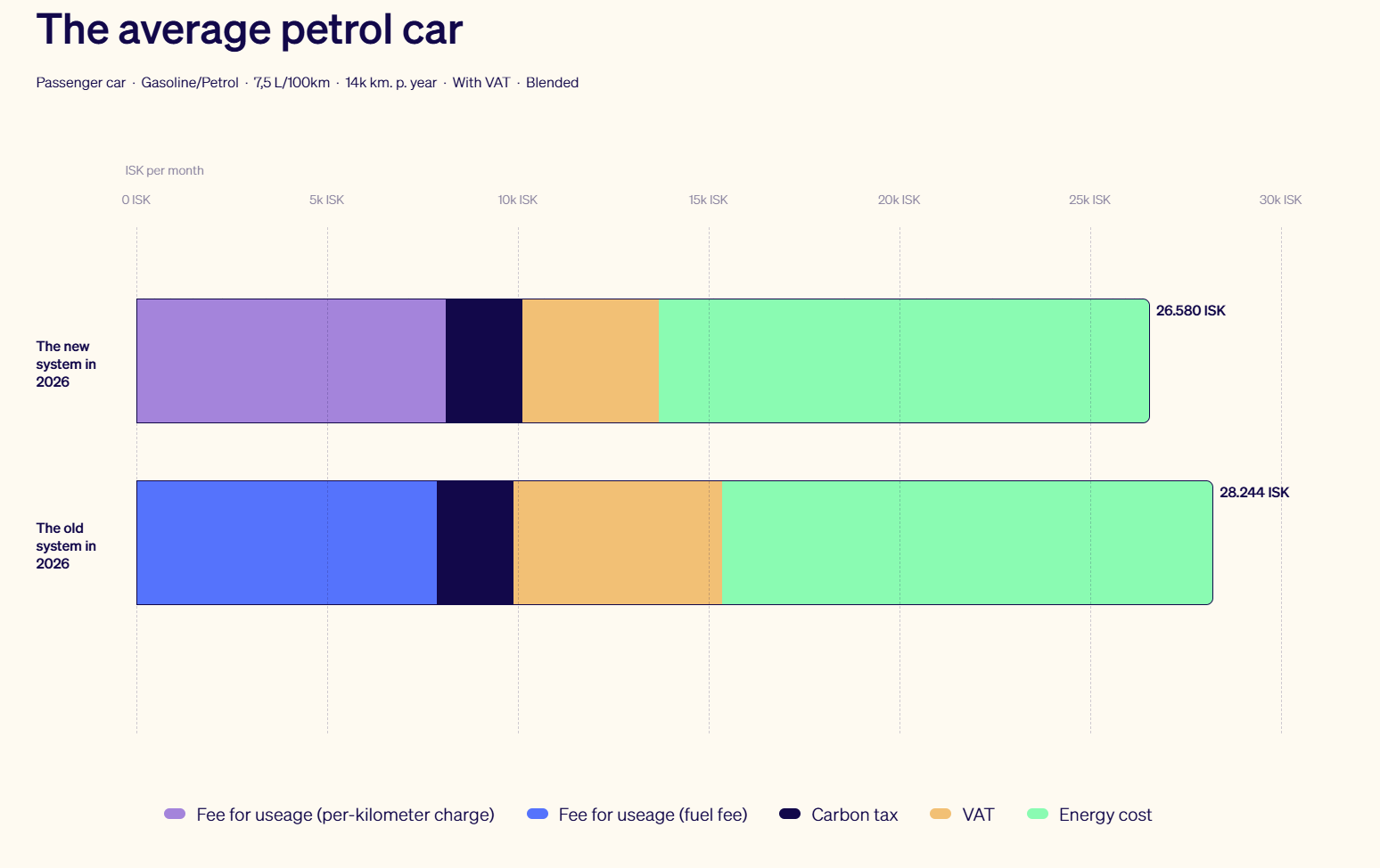
- The tax replaced part of the fuel tax, so pump prices dropped when the system launched in January 2026. How that nets out for your trip depends on how far you drive and current fuel prices, so it's worth checking live prices before you travel.
- Unlimited mileage is unaffected. The tax is a flat daily fee, not a per-kilometer charge, so driving further doesn't cost more.
Rates and figures reflect the system as confirmed for its January 2026 launch. Government charges can be revised over time, so it's worth checking current terms with your rental company, or the Icelandic Road Administration (Vegagerðin) for the underlying policy, before you book.
What is the Iceland road tax and why was it introduced?
The Iceland road tax is a national charge introduced to fund road maintenance and infrastructure, replacing a system that relied heavily on fuel taxes. Under the old model, electric vehicles contributed very little toward road upkeep despite using the same roads as petrol and diesel cars, the new tax closes that gap by charging based on road use rather than fuel consumption.
This matters for visitors because it applies uniformly. Whether you're driving a compact 2WD hatchback around the Golden Circle or a 4x4 out toward the Westfjords, the underlying tax obligation is the same. The government structured the charge on a per-kilometer basis technically, but how that's billed to you depends on your rental company.
How Blue Car Rental applies the road tax to your booking
Rather than tracking your kilometers during the trip, Blue Car Rental converts the government's per-kilometer mandate into a fixed daily rate of 1,550 ISK, calculated across the length of your rental and charged up front at booking. You see the total cost before you even land in Iceland, there's no odometer check at return and nothing added to your final bill.
| Rental length | Road tax at 1,550 ISK/day |
|---|---|
| 3 days | 4,650 ISK |
| 7 days | 10,850 ISK |
| 14 days | 21,700 ISK |
Rate confirmed for Jan 2026 launch; last checked August 2026, verify current rate before booking.
The daily rate is identical across vehicle types, so an EV rental carries the same road tax line as a petrol or diesel one. If you extend your rental, each extra day adds 1,550 ISK to the total. If you shorten it, contact Blue Car Rental at the time of the change to confirm whether unused days are adjusted, since this depends on the modification terms in effect at that time.
What the road tax replaced, and what happened to fuel prices
The road tax largely replaces the fuel-tax component that used to be baked into the price at the pump. That's why pump prices moved when the system launched in January 2026, fuel taxes were cut as the road tax took over funding road maintenance.
Exactly how much cheaper fuel is at any given moment depends on ongoing market conditions, so the only reliable way to judge your trip's fuel budget is to check current prices at Icelandic fuel retailers such as N1 or Orkan before you travel. If you're trying to plan a realistic overall budget, our guide on prices in Iceland and what to expect from car hire is a useful companion to this page.
A worked example: a 7-day Ring Road trip
Say you're renting a car for seven days to drive the Ring Road (Route 1) and a few detours. The road tax on that booking is a fixed 10,850 ISK, settled at the time you book. That figure doesn't change whether you drive 1,200 km or 2,000 km over the week, a full Ring Road loop often falls in this broad range depending on route and detours.
This is where the flat daily structure works in a traveller's favor compared to a true per-kilometer charge: routes like the Ring Road, or longer detours into the Westfjords, rack up distance quickly, but your road tax total stays fixed regardless. Whether your overall trip cost comes out ahead of a similar trip in previous years depends on your route length and what fuel is doing at the time, not on the road tax itself, which is predictable from the moment you book.
What the road tax does not cover
The road tax is separate from other charges you may encounter on Icelandic roads, and it's worth knowing the difference so you're not caught off guard.
- Tunnel tolls. The Vaðlaheiði tunnel near Akureyri, for example, charges its own toll at the time of use. Rates are set by the tunnel operator and can change, so check the current figure directly with the operator before your trip. The road tax does not cover or offset this.
- Parking fees. Paid parking areas at sites such as Þingvellir or Skaftafell are billed on the spot by the driver, independent of the road tax.
- Insurance. Every Blue Car Rental booking already includes CDW, SCDW, Gravel Protection, Theft Protection and Third-Party Liability as standard cover, these are insurance products, not road funding, and are priced and applied separately from the road tax line. You can review what's included on our insurance and coverage page.
None of these are replaced by the road tax, and none of them replace it either, they're simply different charges that can appear on the same trip.
Mistakes worth avoiding
Confusing the road tax with a deposit. The road tax is a fixed charge for road use, settled at booking. It has nothing to do with the credit-card imprint taken as security at pickup, which is a credit-card imprint held as a security guarantee, not a deposit. If that distinction is unclear, our piece on car rental deposit options in Iceland explains how that separate process works.
Expecting an odometer reading at drop-off. There isn't one for the road tax. Since it's charged as a flat daily rate at booking, returning the car involves no additional calculation on this line.
Assuming electric vehicles are exempt. They're not, one of the specific goals of the 2026 reform was to make EVs contribute to road funding alongside petrol and diesel vehicles. The daily rate is the same across all vehicle types.
Treating it as a hidden fee. It isn't meant to be one. A named, fixed line at booking is a different thing from the kind of surprise charge covered in our guide to hidden costs when renting a car in Iceland, the road tax should appear clearly in your quote, not buried at return.

How the road tax fits into your overall Iceland rental budget
The road tax is one line among several that make up the total cost of a self-drive trip, alongside the vehicle rate, any optional insurance upgrades, fuel, and charges like tunnel tolls or parking. Because it's fixed and disclosed at booking rather than usage-based, it's one of the more predictable parts of the budget.
If you're trying to plan realistically for a longer trip, it's worth reading through our broader guide on how to keep your Iceland car rental costs down, which covers the levers that actually move your total price, vehicle size, season, and rental length, alongside fixed charges like this one.
 PARKING IN REYKJAVÍK: ZONES, PAYMENT, AND WHERE TO LEAVE YOUR CAR