
Most surprise charges on an Iceland car rental invoice come from a handful of predictable places: insurance gaps, fuel policy, extra drivers, equipment, and how a company handles cleaning or card holds. None of these are secret, they're just easy to miss when you're comparing a low headline price against a fuller one.

Short answer: Yes, car rental in Iceland can carry hidden costs, mainly from insurance add-ons, fuel refilling penalties, extra driver fees, and after-hours pickup charges. The way to avoid them is to book with a company that states its inclusions clearly upfront (what's covered by default, what an additional driver costs, whether cleaning is included) rather than choosing on base price alone. Blue Car Rental, for example, includes CDW, SCDW, Gravel Protection, Theft Protection and Third-Party Liability in every rental, and takes a credit-card imprint rather than a deposit, so there's no blocked funds to chase up afterwards.
Insurance gaps that turn into big bills
The single biggest source of unexpected cost in Iceland is insurance that looks included but isn't. A low base rate often excludes exactly the coverage you're most likely to need on Icelandic roads, gravel chips, sand-blasted paint, wind-torn doors.
Iceland's driving conditions create specific risks that don't come up in most other countries:
- Gravel roads are common outside Reykjavík, and loose stones chip windshields and scratch paintwork.
- Sand and ash on the South Coast and in exposed highland areas can strip paint during a windstorm.
- Strong wind gusts can catch a car door and bend it back on its hinge if you're not holding it.
- Water damage from river crossings is excluded under many companies' standard terms; with Blue Car Rental it is covered by the Liability Waiver, for legal crossings only.
Repair costs for these are not trivial: according to local windshield and body-repair shops, a windshield replacement can cost roughly €1,000–€1,650 in total, with cars that have windshield cameras usually at the higher end (checked October 2026), while sand damage can exceed €2,000 and wind-related door repair can run €1,500 or more (figures from a check in September 2025; costs may have risen since, so always confirm current repair costs with your provider).
Every Blue Car Rental booking includes CDW, SCDW, Gravel Protection, Theft Protection, and Third-Party Liability as standard, these aren't add-ons you need to remember to select. Tyre cover, however, sits under the optional Liability Waiver, along with cover for sand and ash damage, wind-door damage, underbody damage, and water damage from legal river crossings. Illegal crossings or off-road driving are not covered by any package, see our driving in Iceland is off-road driving illegal guide for what counts as legal driving.

Rather than comparing base prices between companies, compare what's actually bundled. The insurance options page breaks down exactly what each package covers so you can see the difference before you book.
Fuel costs and how they add up
Fuel in Iceland is genuinely expensive by international standards, and the way you handle refuelling affects your final bill more than most travellers expect. As of 12 October 2026, 95-octane petrol cost between 253 and 287 ISK per litre at Icelandic stations, with most charging about 282 ISK, and diesel cost between 303 and 333 ISK per litre, with most stations at about 327 ISK (Gasvaktin). Separately, Iceland introduced a kilometre-based road tax in January 2026 (FÍB summary of the change). Blue charges it as a fixed 1,550 ISK per rental day, collected at booking as its own line (last checked September 2026; see our road tax guide). These figures move with global oil prices, so check current rates via the N1, Orkan, or Olís apps before your trip.
The most common way travellers overpay is returning the car with less than a full tank, which typically triggers a refuelling penalty on top of the fuel cost itself. The fix is simple: always fill up at the last station before drop-off. You can also trim the fuel bill itself. Every Blue Car Rental key comes with a discount chip that gives 7 ISK off every litre of fuel at Olís and ÓB stations in Iceland, and most fuel chains take 10 to 12 ISK off per litre with their own discount key ring or card, although not at their lowest-price stations.
Diesel vehicles often return better fuel economy on long stretches like the Ring Road, which is worth factoring in if you're covering a lot of distance. If you'd rather skip fuel stops altogether, an electric car rental is now a realistic option on many routes, with charging infrastructure spread across the country. For a full breakdown of what fuel actually costs on a typical route, see our fuel prices guide.
Additional driver fees
If more than one person in your group will be driving, every named driver needs to be listed on the rental agreement, unlisted drivers are not covered by insurance if something happens. Most companies charge a daily fee per additional driver, typically in the €5–€15 range, and this is one of the more commonly searched costs by travellers planning a self-drive trip specifically because it's easy to forget when budgeting.
The fee itself isn't unusual, what varies is whether it's shown clearly before you arrive. Ask for the additional driver rate at the time of booking rather than at the counter, so it's factored into your total cost rather than appearing as a surprise line item at pickup.
Young driver surcharges
Age-based surcharges are standard across the Icelandic rental industry, not a hidden fee unique to any one company, but they're often buried in the fine print rather than stated plainly. Drivers under 25 are frequently treated as higher risk and charged an extra €10–€30 per day depending on the company and vehicle class.
Minimum age limits generally sit between 20 and 23 depending on the vehicle category (a compact 2WD versus a larger 4x4, for instance). The detail worth checking before you book is whether that age limit comes with a daily surcharge on top, or whether it's simply a cutoff with no extra charge once you meet it.
Equipment add-ons: GPS, Wi-Fi, and child seats
Extra equipment is one of the easiest costs to control, because it's entirely optional and easy to price-check in advance. Blue Car Rental lists its current prices for 4G Wi-Fi, GPS and child and booster seats on its extras page.

A few ways to reduce or avoid this cost entirely:
- Download offline maps (Google Maps or Maps.me) before you leave home.
- Use your own phone with an Icelandic SIM, or add Blue Car Rental's 4G Wi-Fi, which connects up to 8 devices rather than a single phone.
- If you do need a child seat, book it in advance rather than requesting one at the counter, availability isn't guaranteed on arrival, and pre-booking avoids delay as well as cost surprises.
Tolls, parking, and fines
Iceland has very few road tolls, but parking rules in Reykjavík are strict and unfamiliar to most visitors, which makes fines one of the more common unplanned costs of a trip.
Two road tolls are worth knowing about. The first is Vaðlaheiðargöng, the tunnel near Akureyri in North Iceland, at 2,216 ISK per crossing for a standard car, about €16, paid online up to 24 hours before or after driving through (last checked October 2026, confirm the current toll on the official Vaðlaheiðargöng payment site). An unpaid toll is billed to the rental company with a 2,000 ISK service fee added. The second is the new Hornafjarðarfljót bridge on Route 1 near Höfn, tolled since 1 September 2026 and billed automatically by number plate (1,500 ISK per crossing, last checked September 2026). In Reykjavík, paid parking operates on a zone system with four numbered zones, P1 to P4, with P1 the most central and most expensive. Charging hours and rates differ by zone and change from year to year, so read the sign at the start of the street or check the Parka app rather than relying on a remembered figure. Parking fines for unpaid or expired sessions can exceed €50, which is easily avoided by paying through the Parka app rather than guessing at a machine. For a fuller walkthrough of where to park and how zones work, see our Reykjavík parking guide.
After-hours pickup and drop-off fees
Many flights to Keflavík arrive outside standard office hours, and some rental desks charge extra, often €50–€100, for pickup or drop-off outside their listed hours. This is worth checking before you book rather than after you land, especially if your flight is scheduled for early morning or late evening.
Blue Car Rental offers key-box pickup (for customers who add the Liability Waiver and complete online check-in at least 24 hours before arrival; available 24/7 at Keflavík Airport and 06:00-21:00 at the Reykjavík office) and drop-off arranged around your flight time, along with online check-in so the paperwork is done before you arrive, useful if you're landing at an odd hour and want to get straight to your accommodation rather than waiting at a counter. Confirm your pickup time and any after-hours arrangement in advance, since it typically needs to be scheduled ahead of arrival rather than requested on the spot.

Highland and F-road use fees
You can't take a rental car outside Iceland, so cross-border fees don't apply, but highland driving has its own rules, and getting them wrong can void your insurance entirely rather than just cost you a fee. F-roads legally require a 4x4, and in winter the highland network is closed regardless of vehicle type.
Before heading onto any F-road:
- Check current road status at umferdin.is and conditions at safetravel.is, F-road opening dates vary by year and by specific road.
- Confirm your vehicle is rated for the route you're planning; not every 4x4 is approved for every F-road.
- If you're unsure about a river crossing on a route, the safe choice is to turn around rather than attempt it, this is also the only scenario where insurance coverage becomes genuinely uncertain, since illegal crossings and off-road driving aren't covered by any package.
Our guides on F-roads and the highlands and whether you need a 4x4 go into more detail on which routes require what.
Cleaning fees
Icelandic roads get vehicles dirty quickly, this happens on the Ring Road and Golden Circle, not just in the highlands, and there's no rule against returning a car with normal road dirt on it. Some companies charge €50–€100 for a car returned muddy, which catches travellers off guard since a dusty exterior after a day of driving is completely normal in Iceland.
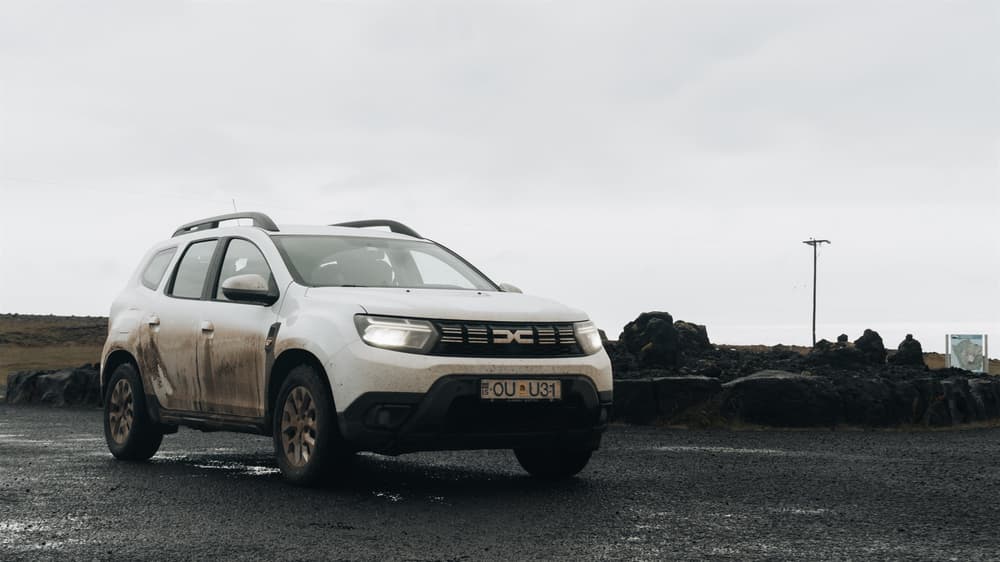
Normal cleaning is included in a Blue Car Rental booking. The exception is excessive interior dirt, sand ground into upholstery, spilled food, that kind of thing, which may incur a charge, the same way it would with any rental company. You don't need to wash the car yourself before returning it; in fact, doing so isn't necessary and won't affect your bill either way.
Currency, card holds, and the deposit question
This is where the "will I get ripped off?" worry tends to concentrate, and it's a fair concern, large holds on a credit card are one of the more disruptive surprises in car rental generally, not just in Iceland. Many companies place a hold of €1,000–€3,000 on your card at pickup, which can take weeks to release even after a clean return.
Blue Car Rental does not take a deposit. Instead, a credit-card imprint is taken as security at pickup, no funds are held or blocked on your card. That distinction matters practically: you're not carrying a large temporarily-frozen balance during your trip, and there's nothing to chase up with your bank afterwards.
Separately, be aware that prices quoted in a foreign currency are always ultimately charged in ISK, so the amount on your statement can shift slightly with exchange rates between booking and travel. Paying in advance where possible makes budgeting more predictable.
If you're a repeat visitor, it's also worth checking the Blue+ loyalty programme, which offers tiered discounts (Bronze at 5% instant, Silver at 10% from 250 points, Gold at 15% from 400 points), a legitimate way to lower your total cost rather than a fee to watch out for.
Hidden cost categories at a glance
| Cost category | Typical range if not included | What to check before booking |
|---|---|---|
| Gravel, sand/ash, wind, tyre cover | €10–€40/day if sold separately | Ask what's standard vs. under a Liability Waiver |
| Fuel refuelling penalty | Varies by provider | Fill up before drop-off; check current fuel prices via N1/Orkan/Olís apps |
| Additional driver | €5–€15/day | Confirm rate at booking, not at the counter |
| Young driver surcharge | €10–€30/day | Ask if the age limit comes with a daily fee attached |
| GPS / Wi-Fi / child seat | Listed per item on the extras page | Pre-book to guarantee availability and lock in the price |
| After-hours pickup/drop-off | €50–€100 | Confirm arrangement in advance for early/late flights |
| Cleaning (excessive dirt only) | €50–€100 | Normal road dirt should not be charged |
| Credit card hold | €1,000–€3,000 | Ask whether it's a deposit/hold or just a card imprint |
Market ranges in this table come from a check in September 2025 and may have changed since; they vary by company, vehicle class, and season. Always confirm current terms before booking.
The bottom line on hidden costs
The fear behind this question is usually not "what will I be charged" so much as "will the final bill match what I thought I booked." That's a reasonable thing to want reassurance on, and the answer is: it depends entirely on how clearly a company states its inclusions before you hand over your card. Insurance coverage, additional driver fees, fuel policy, and card handling are the four areas most worth checking line by line, everything else in this guide is smaller in scale.
For a broader look at what a full trip typically costs, see our guide to car hire prices and what to expect in Iceland.
 PARKING IN REYKJAVÍK: ZONES, PAYMENT, AND WHERE TO LEAVE YOUR CAR