If you've booked a rental car in Iceland with two family members whose surnames don't match, or noticed that Icelandic siblings can carry different surnames, you've run into the patronymic naming system. This article explains what "dóttir" and "son" actually mean, how the system works today, and why it still shapes Icelandic identity, including on football jerseys and CrossFit uniforms.
Short answer: Icelandic surnames are not inherited family names. They're built from a parent's first name plus "dóttir" (daughter) or "son" (son). So Katrín, daughter of Björn, is Katrín Björnsdóttir, while her brother Jón is Jón Björnsson. Most children still take the father's name, but naming after the mother (a matronymic) is legal and increasingly common. Spouses usually keep their own surnames, since there is no inherited family name to take on.
What does "dóttir" mean in Icelandic?
"Dóttir" is the Icelandic word for "daughter." When it's attached to the end of a parent's first name, it indicates whose daughter someone is, not a family name passed down through generations. So Guðrún Ólafsdóttir means "Guðrún, daughter of Ólafur." If Ólafur has another daughter, Anna, she'd be Anna Ólafsdóttir too. Siblings share the "dóttir" or "son" ending only because they share a parent, not because they belong to a fixed family surname line.
This is the detail that trips up most visitors researching "dottir meaning", it's not a surname in the Western sense at all. It's a description of a relationship, refreshed with every generation.
Why do Icelandic names end in "son"?
The male equivalent works the same way, using "son" (son) instead of "dóttir." Björn's son Magnús becomes Magnús Björnsson, "Magnús, son of Björn." If Magnús later has a son of his own, that child won't be a Björnsson too; he'll take Magnús's first name and become, for example, Jón Magnússon. The surname resets every generation rather than staying fixed across a bloodline, which is the core difference between Icelandic naming and the family-name systems used in most of Europe and North America.
How the patronymic (and matronymic) system works
The pattern is consistent: take a parent's first name, add "-son" for a son or "-dóttir" for a daughter, and that becomes the child's last name. Traditionally the father's name was used, but Icelandic law also allows a matronymic, a surname built from the mother's first name, and this option has become noticeably more common in recent decades as part of a broader move toward gender equality in naming.
| Parent's name | Child | Surname formed | Meaning |
|---|---|---|---|
| Björn | Daughter: Katrín | Katrín Björnsdóttir | Daughter of Björn |
| Björn | Son: Jón | Jón Björnsson | Son of Björn |
| Guðrún (mother) | Daughter: Sara | Sara Guðrúnardóttir | Daughter of Guðrún |
| Guðrún (mother) | Son: Ari | Ari Guðrúnarson | Son of Guðrún |
Because the surname is generated fresh each generation, two full siblings will share a surname, but a parent and child almost never will (unless the parent's first name happens to be given again down the line). That single fact explains most of the "why do family members have different last names" confusion visitors run into.
Why did Iceland keep this system when other countries didn't?
Iceland is small, historically isolated, and was settled and largely self-governing for centuries with a population that, for most of its history, numbered in the tens of thousands. In a tight-knit society where many people were related in some way, a patronymic naming system that resets each generation was more practical for day-to-day identification than a fixed family surname shared by an ever-expanding clan.
The tradition also has deep roots in the Icelandic sagas, where characters, including the old Norse gods and the Viking settlers of the 9th and 10th centuries, are consistently introduced as "so-and-so's son" or "so-and-so's daughter." Iceland is somewhat unusual today in having preserved this system almost unchanged, while neighbouring Nordic countries largely phased out patronymics in favour of fixed family surnames as their populations grew and administrative record-keeping modernised.
| System | How it works | Example | Where it's used today |
|---|---|---|---|
| Icelandic patronymic/matronymic | Parent's first name + son/dóttir, resets each generation | Björnsson, Björnsdóttir | Iceland (standard practice) |
| Fixed family surname | Surname inherited unchanged across generations | Smith, Johnson, Müller | Most of Europe, North America, Australia |
| Historical Nordic patronymic | Same principle as Iceland's, largely discontinued | Andersson (frozen as family name) | Sweden, Norway, Denmark (historians note patronymics were phased out roughly from the 18th–19th century, though exact dates vary by country) |
| Faroese naming | Similar patronymic roots, family names now more common | Similar structure to Icelandic | Faroe Islands (mixed system today) |
Do married couples in Iceland share a surname?
No. Since Icelandic surnames describe a parent-child relationship rather than a family unit, there's no shared family name for a married couple to adopt. A husband and wife in Iceland typically keep the surnames they were born with for life. This is worth knowing before you travel, because it means a married couple, or parents and their adult children, can turn up on a booking, hotel reservation, or ID check with three completely different surnames, which occasionally surprises visitors who assume it's an error.
It's a useful thing to keep in mind when you're organising travel documents for a group. When you book a rental car in Iceland, each driver is listed individually by their own legal name rather than under a shared family surname, so there's nothing unusual about a booking showing several unrelated-looking names for one travelling family. If you're using online check-in ahead of a Keflavik Airport pickup, many travelers find it helpful to double-check that each driver's name is entered exactly as it appears on their passport or licence, since Icelandic naming conventions differ from what's typical elsewhere. If anything about names on a booking looks unclear, the FAQ page or the Keflavik Airport pickup information is a good place to check before you arrive.
"Dóttir" as a modern symbol, not just a suffix
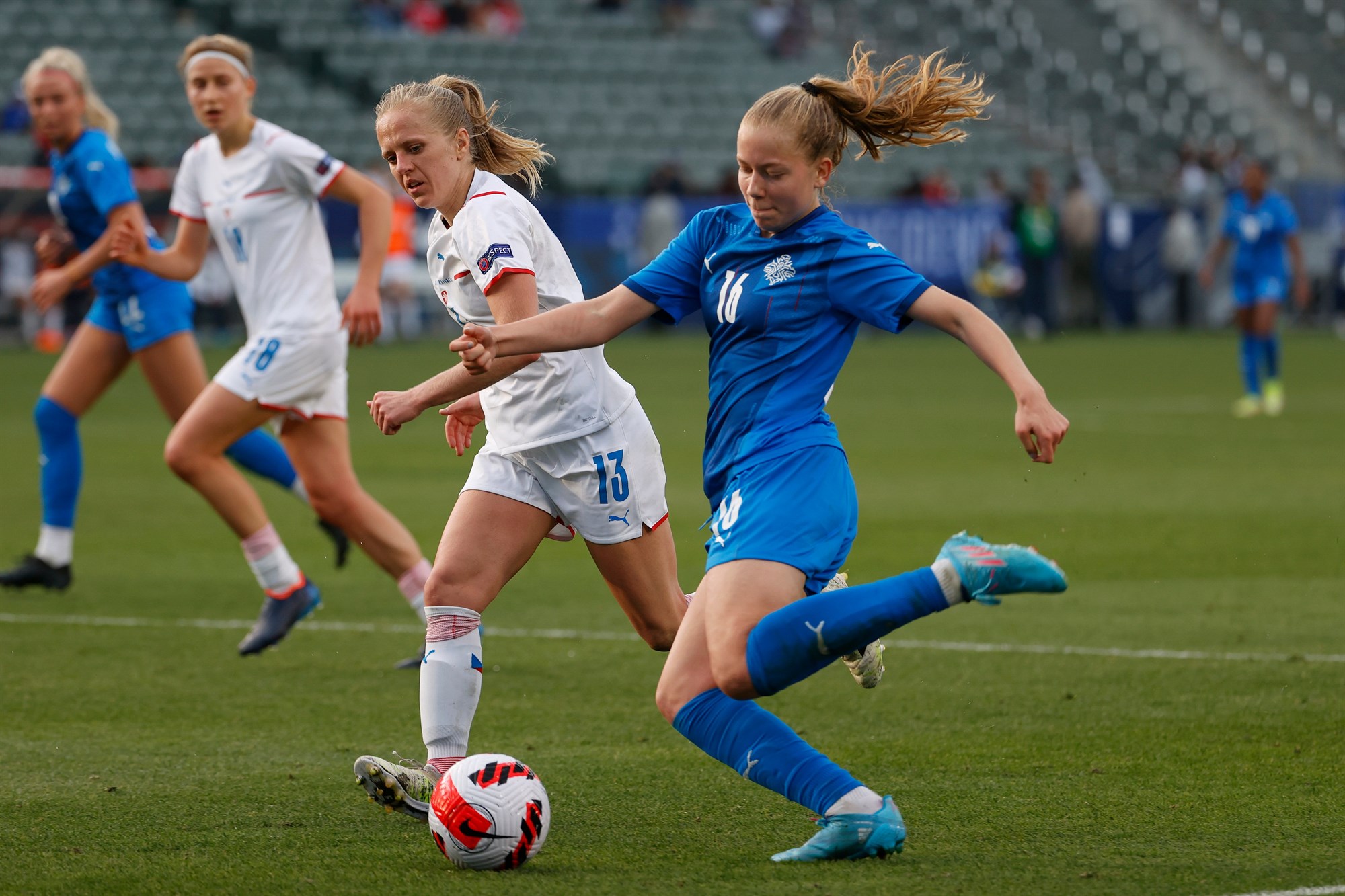
In the last decade, "Dóttir" has taken on a life of its own as a cultural symbol, particularly for Icelandic women in international sport. CrossFit athletes Annie Mist Þórisdóttir and Katrín Tanja Davíðsdóttir, both world champions, helped popularise "Dottir" as a name printed across competition uniforms, a shorthand for Icelandic identity, strength, and unity rather than a literal surname. The Icelandic women's national football team adopted the same idea, wearing "Dóttir" on their shirts during international tournaments, including the UEFA Women's Euro. In both cases, the word has shifted from a grammatical suffix meaning "daughter of" into a standalone badge of where these athletes are from.
Mistakes to avoid when thinking about Icelandic names
A few assumptions catch visitors out. First, don't assume a shared surname means a close, ongoing family line, Björnsson and Björnsdóttir siblings share a surname only because of their father, not a family dynasty. Second, don't expect married couples, or parents and adult children, to share a last name on hotel bookings, car rental paperwork, or restaurant reservations, different surnames within the same family are completely normal. Third, resist guessing someone's father's or mother's name from their surname alone; while it's a fun icebreaker to ask, it isn't always accurate given how names are also inherited, chosen, or (in some cases) fixed as genuine family surnames among Iceland's small population of exceptions.
A good conversation starter
Asking an Icelander for their full name is a low-key way to learn something real about them, since the answer usually tells you the first name of one of their parents as well as their own. It's a pleasant, easy way to strike up conversation with locals during a self-drive trip, at a petrol station, a guesthouse, or over coffee in a small town along the Ring Road. Some visitors enjoy working out what their own name would look like under the Icelandic system as a light-hearted way to engage with the culture during their stay.
 HOW BLUE CAR RENTAL SUPPORTS LOCAL COMMUNITIES IN ICELAND