
Short answer: Renting a car in Iceland is straightforward once you book ahead, match the vehicle to your route and season, and read what's actually included in your insurance before you sign. A 2WD car is fine for the Ring Road and Golden Circle in summer; a 4x4 is legally required on F-roads and strongly recommended for winter driving. Most visitors pick up at Keflavik Airport (KEF), where online check-in can cut down the time spent at the counter.
How renting a car in Iceland actually works
Booking is done online, in advance, choosing your dates, pickup location, vehicle class and any insurance upgrades. You'll get a confirmation with pickup instructions, then complete the rest, driver's licence check, contract, key handover, either at a desk, via a shuttle, or through a self-service key-box if the company offers one.
Blue Car Rental's process at Keflavik follows this pattern: you can complete online check-in before you fly, which speeds up collection once you land, and pickup itself is covered in more detail in the Keflavik Airport pickup guide. If you'd rather understand the full booking flow first, vehicle class, insurance, and pickup in one place, the step-by-step booking guide walks through it.
Choosing a vehicle for your route and season
The right car depends on where you're going and when, not on what looks good in photos. A compact 2WD is genuinely enough for a Reykjavik-based trip with day tours; a 4x4 becomes necessary the moment your route includes gravel mountain roads or winter conditions.
| Vehicle type | Best suited for | Season notes | Legal on F-roads? |
|---|---|---|---|
| Compact/economy 2WD | Reykjavik, Golden Circle, South Coast on paved roads | Fine in summer; not recommended in winter | No |
| Mid-size 2WD | Ring Road in summer, couples or families with luggage | Comfortable in summer; check winter tyres if travelling Oct–Apr | No |
| 4x4 SUV | Highlands, gravel backroads, winter driving anywhere | Recommended Nov–Mar; required for F-roads, which typically open only in summer | Yes |
| Electric car | Reykjavik and Ring Road with planned charging stops | Range and charging spacing should be checked against your route | No (Blue's rental terms) |
| Van/minibus | Groups, families needing extra seats or luggage space | Available year-round; check winter suitability per model | Varies by model |
You can browse current vehicle classes on the our cars page to see what's available for your dates.
Do you actually need a 4x4?
For F-roads, yes, a 4x4 is a legal requirement, not just a comfort choice. For paved routes like the Ring Road or Golden Circle in summer, a well-maintained 2WD is usually sufficient.
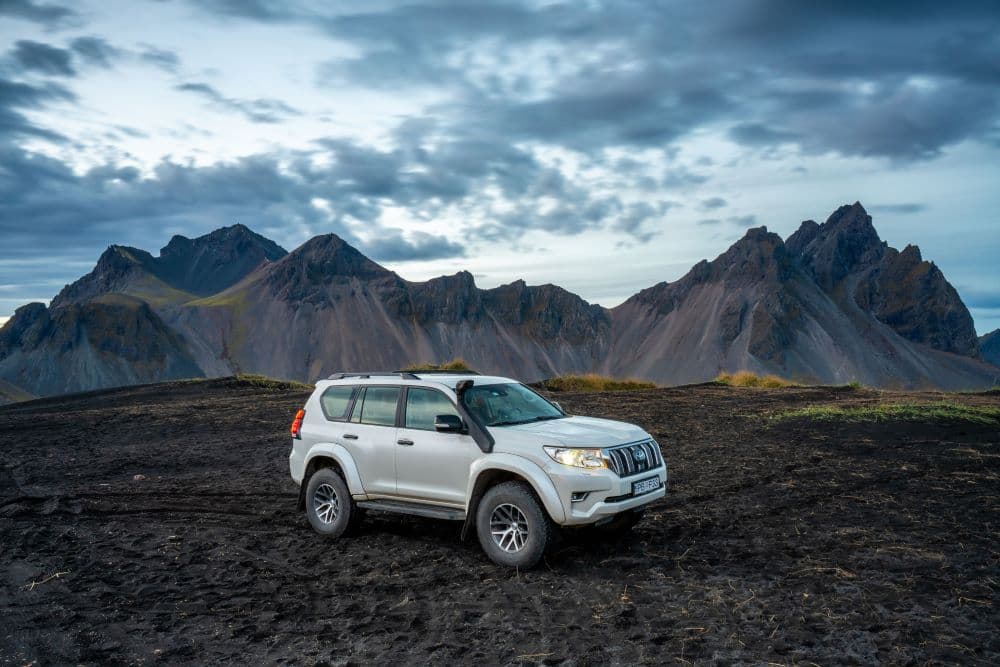
Winter changes the calculation: snow, ice and sudden weather shifts make a 4x4 with winter tyres the safer default between roughly November and March, even if you're only doing day trips near Reykjavik. If you're still unsure which category fits your plans, the 7 questions to ask yourself before booking a 4x4 and the comparison of 4x4 vs 2WD by route and season go through this in more detail. If the Highlands or any F-road (Kjölur, Landmannalaugar, Askja) is on your itinerary, read the rental car guide to F-roads before you book.
What Iceland car rental insurance actually covers
Every Blue Car Rental booking includes Collision Damage Waiver (CDW), Super Collision Damage Waiver (SCDW), Gravel Protection, Theft Protection and Third-Party Liability as standard. Tyre damage is covered only under the Liability Waiver (LW) upgrade, which also covers water damage, including legal river crossings, underbody damage, wind-door damage, and sand & ash damage.
This matters because gravel chips and sandblasting from wind-blown volcanic sand are two of the most common damage claims in Iceland, particularly on the South Coast around Vík. Illegal river crossings or off-road driving are not covered by any policy, nothing bridges that gap, so it's not a case of paying more for extra cover.
| Coverage | Included by default | What it covers |
|---|---|---|
| CDW | Yes | Collision damage, with a deductible |
| SCDW | Yes | Reduces the CDW deductible |
| Gravel Protection | Yes | Body and windscreen damage from loose gravel |
| Theft Protection | Yes | Theft of the vehicle |
| Third-Party Liability | Yes | Damage or injury caused to others |
| Liability Waiver (LW) | Optional upgrade | Tyres, legal river crossings, underbody, wind-door, sand & ash |
Blue Car Rental takes a credit-card imprint as security at pickup rather than holding or blocking funds, no deposit is taken from your account. For a broader look at how deposits and insurance interact across providers, see car rental pricing, deposits and insurance and deposit options explained. The insurance page has the full policy wording. If gravel damage is your main concern, the gravel protection breakdown is worth a look.
Picking up at Keflavik Airport and driving into Reykjavik
Most international flights land at Keflavik International Airport (KEF), not the small domestic airport (RKV) in Reykjavik, double-check this when booking, since the two are sometimes confused. From KEF, Reykjavik is roughly 45 minutes by car along Route 41 (Reykjanesbraut).
If your first stop downtown is somewhere like Sandholt bakery on Laugavegur, the drive itself is simple: follow Route 41 into the city, then city streets to Laugavegur. The part that actually takes planning is parking once you arrive, Reykjavik uses metered pay-by-zone parking in the city centre, covered in the parking guide for Reykjavik. For exact pickup logistics and location details at the airport, see the Keflavik Airport location information.
Driving in Iceland in July
July offers close to 24-hour daylight and the mildest driving conditions of the year, which makes it the easiest month for a first self-drive trip. Roads that are closed or risky in winter, including many F-roads in the Highlands, are typically open by summer, though exact opening dates vary year to year and should be checked on umferdin.is before you go.
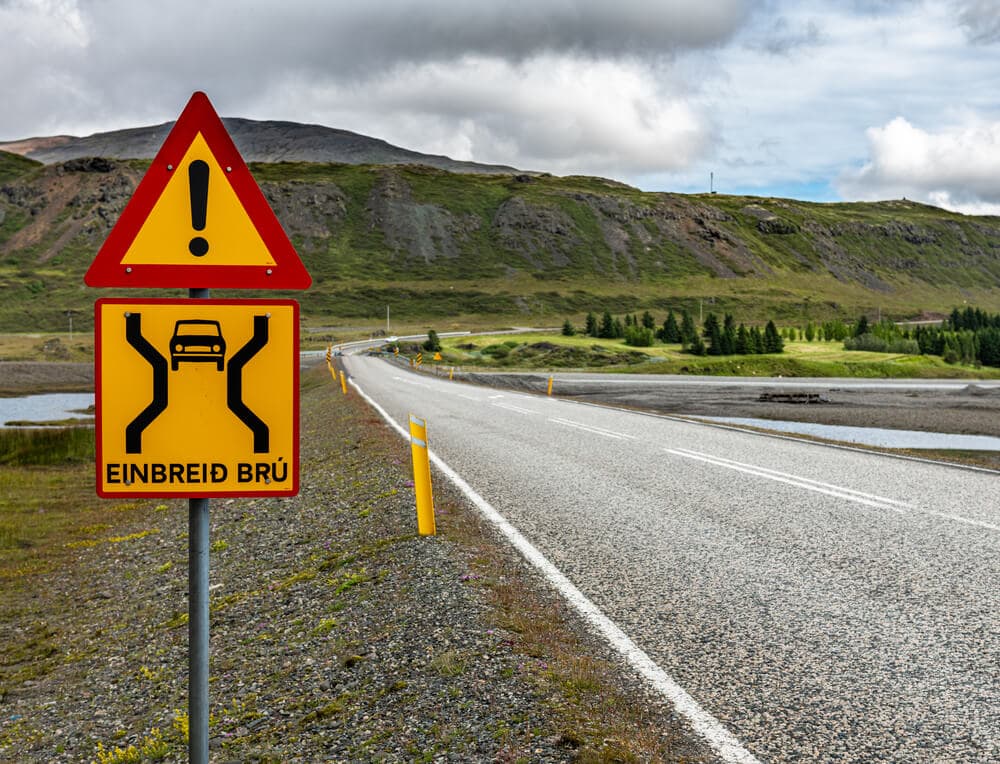
That said, July isn't without its own considerations: wind can still be strong in open areas, gravel roads raise dust that reduces visibility when passing other vehicles, and the Ring Road and Golden Circle see the heaviest tourist traffic of the year, so single-lane bridges and narrow pull-outs need extra patience. For a broader look at conditions across the year, the general driving in Iceland guide is a useful companion, and if winter is also part of your trip planning, the winter driving guide covers what changes.
Road rules that catch first-time visitors off guard
A handful of rules differ from what many visitors are used to, and they're worth knowing before you're on the road rather than learning them from a sign. Headlights must be on at all times, day or night, it's a legal requirement, not a suggestion. Speed limits are generally 90 km/h on paved rural roads, 80 km/h on gravel roads, and 50 km/h in urban areas, enforced with speed cameras. Seatbelts are mandatory for everyone in the car.
Off-road driving is illegal across Iceland, on any terrain, at any time of year, the off-road driving law explained covers why this is enforced so strictly and what the fines look like. Single-lane bridges run on a first-come, first-served basis: slow down as you approach and give way if another car is already crossing. In roundabouts, traffic already inside the roundabout has right of way over cars entering it.
River crossings and F-roads
F-roads legally require a 4x4, and some F-roads include unbridged river crossings. This isn't a situation where local knowledge or careful driving overrides the road itself, if you're uncertain about a crossing, the right move is to turn around, not attempt it.
Before any Highlands route, check current conditions on umferdin.is and safetravel.is, since river depth and road status change with weather and season. If a route genuinely requires fording rivers, an experienced local operator running guided tours is a more suitable option than a self-drive rental.
Fuel, tolls and other costs to plan for
Fuel in Iceland is priced by the litre and has historically run higher than in much of North America, in October 2026 petrol cost roughly 253 to 287 ISK per litre and diesel 303 to 333 (Gasvaktin price tracker, last checked 12 October 2026), and prices change often, so check closer to your travel dates. Petrol stations can be spaced well over 100 km apart in rural regions like the Westfjords or the interior, so refuelling at half a tank rather than waiting until empty is the safer habit.
Iceland has two tolls on its main roads. One is the Vaðlaheiðargöng tunnel near Akureyri in North Iceland, which charges 2,152 ISK per crossing for a standard car when paid online within three hours of driving through (last checked September 2026, per the tunnel operator); an unpaid toll adds a 2,000 ISK service fee. The other is the new Hornafjarðarfljót bridge on Route 1 near Höfn, tolled since 1 September 2026 and billed automatically by number plate (1,500 ISK for a single trip in a vehicle up to 3.5 tonnes, per Spölur, the toll operator, last checked October 2026). Beyond fuel and those two tolls, the main additional cost to budget for is city parking. Normal cleaning is included in every Blue Car Rental return, only excessive interior dirt is charged, so there's no need to detail the car before drop-off. For a fuller cost breakdown, see car hire costs and what to expect and hidden costs and how to avoid them.
Mistakes to avoid when hiring a car in Iceland
- Booking too late in high season, vehicle availability, especially automatics and 4x4s, tightens up in summer.
- Ignoring loyalty savings, Blue+ members get an instant 5% discount at Bronze, 10% at Silver (250+ points), and 15% at Gold (400+ points); details are on the loyalty page.
The real worry: will there be hidden costs?
Most concerns about renting a car in Iceland come back to one question: will something unexpected show up on the final bill? The clearest way to avoid that is reading what's included before you book rather than after, knowing that CDW, SCDW, Gravel Protection, Theft Protection and Third-Party Liability come standard, that a card imprint (not a deposit) secures the booking, and that normal wear-and-tear cleaning is already covered removes most of the guesswork. Anything genuinely variable is worth a quick check close to your travel dates rather than assumed from an old blog post: fuel prices on Gasvaktin, road tolls with the operators (veggjald.is for Vaðlaheiðargöng, spolur.is for Hornafjörður), and road openings on umferdin.is or safetravel.is.
 RENTING A CAR IN REYKJAVÍK: A COMPLETE GUIDE FOR TRAVELERS